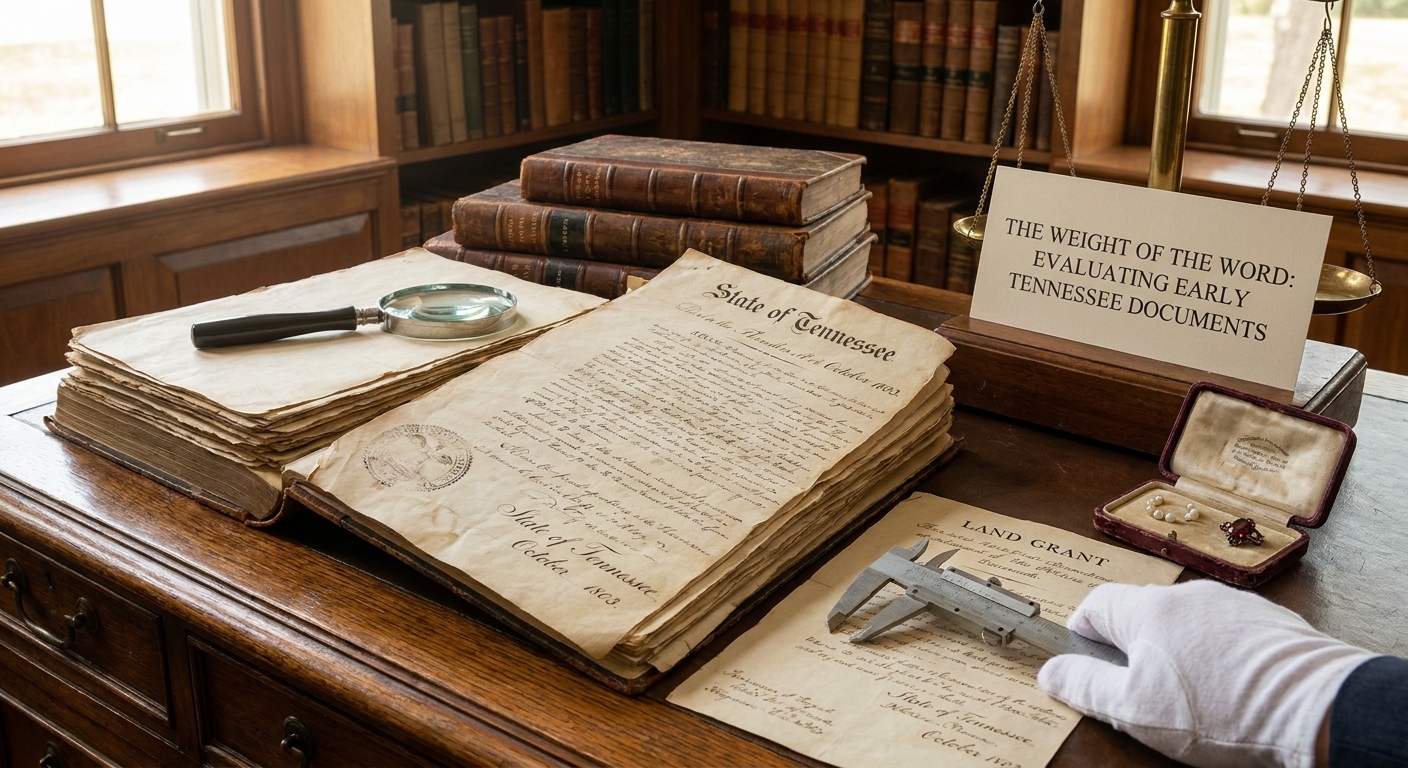
That dusty old box tucked away in an attic corner, perhaps inherited from a great-aunt, often holds more than just faded photographs. Sometimes, nestled among brittle textiles, you find a sheaf of papers tied with a ribbon, their script elegant yet unfamiliar. It might be a land deed from the late 1700s, a handwritten will from the early 1800s, or correspondence detailing life in a nascent Tennessee settlement. The initial rush of curiosity – "What is this?" – quickly gives way to a more pressing question: "What is it worth?" This is a common scene, and it highlights the unique challenges and profound rewards of evaluating early Tennessee documents.
These aren't just pieces of paper; they are tangible links to a formative period, carrying the weight of history, the voices of early settlers, and the very fabric of our state's beginnings. Determining their value, however, requires a meticulous, multi-faceted approach, moving beyond simple age to a deeper understanding of their significance.
One of the most crucial strategies in evaluating these documents is establishing provenance and context. Who created this document? Who owned it, and how did it come into your family's possession? A land grant signed by an early Tennessee governor or a prominent historical figure, for example, inherently carries more weight than a generic promissory note, though even the latter can hold value if it illuminates a specific historical event or person. Understanding the document's original purpose – was it a legal instrument, a personal letter, a public proclamation? – provides vital context. Even a seemingly mundane receipt can become historically significant if it's tied to a notable individual or a pivotal local event, tracing economic activity or social connections.
Secondly, a thorough authenticity and condition assessment is paramount. Is the document genuine? This involves careful examination of the paper itself – looking for watermarks, fiber content, and the typical characteristics of paper from the era. The ink, too, offers clues; iron gall ink was prevalent, and its chemical properties can be distinct. Any signs of alteration, repair, or modern reproduction are critical red flags that must be investigated. Beyond authenticity, condition plays a significant role. A document with severe tears, fading, insect damage, or acidic deterioration will generally command less value than one that has been well-preserved, even if its historical importance is equal. While professional conservation can mitigate damage, it rarely restores the full original market value.
Finally, research and comparative analysis are indispensable. This involves delving into archival records, historical societies, and auction results to see how this particular document compares to similar items in the market. Is it a unique manuscript, or one of many copies? How frequently do comparable items appear for sale? Rarity, combined with demand from collectors, institutions, or researchers, is a powerful driver of value. An early draft of a state constitution would be exceptionally rare, while a standard land deed, though less unique, could still be quite valuable depending on the individuals involved, the location, and the date.
An evidence-based concept that guides much of this work is the "Highest and Best Use" principle, adapted from real estate appraisal. For historical documents, this framework helps us consider the most probable use that is physically possible, legally permissible, financially feasible, and maximally productive. It prompts us to ask: Is this document primarily of interest to a historical institution, a private collector, a genealogist, or an investor? Understanding its primary market appeal helps to accurately frame the valuation.
Just last month, I worked with a client who had inherited a collection of ledgers and correspondence from a distant ancestor, dating to the 1840s. Initially, they viewed them as merely family keepsakes. However, through careful research, we discovered the ancestor was a prominent merchant in a rapidly growing Tennessee river town, and the letters detailed not just personal family matters but also intricate business dealings, local politics, and the daily challenges of frontier life. These documents, initially dismissed, were transformed into invaluable primary source material, significantly elevating their appraised value for a historical archive seeking to complete its regional collection.
If you uncover what you suspect might be an early Tennessee document, resist the urge to "clean" or repair it yourself. Handle it minimally, store it safely in a stable environment, and, most importantly, seek out a qualified personal property appraiser specializing in historical documents. Their expertise can unlock the true story and value held within those fragile, historically rich pages.