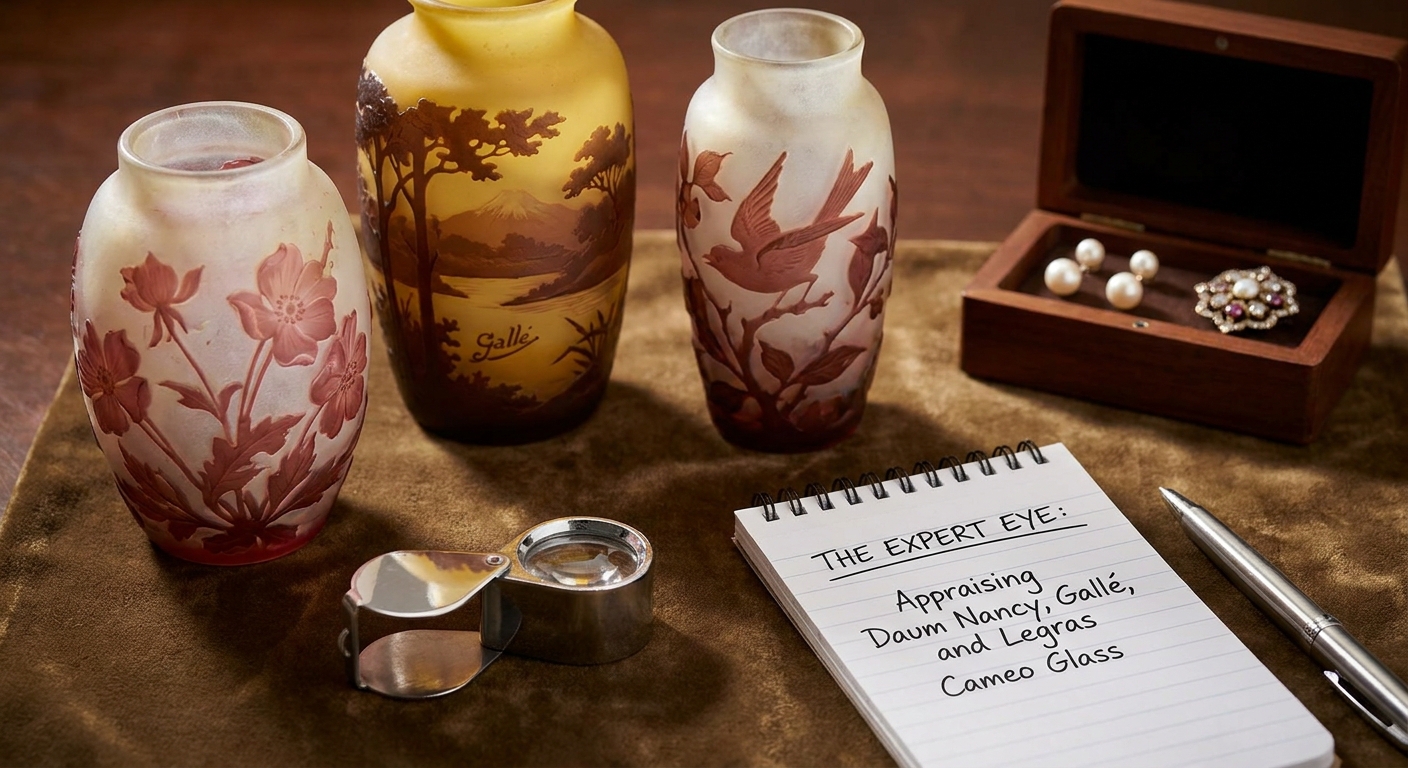
The dusty corner of an inherited attic, often dismissed as mere storage, sometimes holds treasures waiting to be rediscovered. I recall a client who brought in a rather unassuming glass vase, tucked away for decades among old linens. Her grandmother had considered it a "pretty trinket," nothing more. Yet, the moment I saw the subtle layering of colors and the delicate, etched landscape, my appraiser’s instinct immediately sharpened. It wasn't just pretty; it was a significant piece of Daum Nancy cameo glass, a testament to early 20th-century artistry, and its value far exceeded what she could have imagined. This scenario isn't uncommon when dealing with the intricate world of cameo glass from masters like Daum Nancy, Gallé, and Legras.
Appraising these exquisite works is a nuanced process, demanding more than a casual glance. It requires a deep understanding of the techniques, historical context, and signature variations that define each studio. While I’ve spent over a decade appraising jewelry, developing a keen eye for detail in gemstones and precious metals, the distinct artistry of cameo glass presents its own fascinating challenges.
One of the most critical strategies in appraising these pieces is meticulous signature verification. The signatures of Gallé, Daum Nancy, and Legras are not static; they evolved over time, reflecting changes in ownership, production methods, and artistic direction. For example, early Gallé pieces might be signed Cristallerie de Gallé, while later works, after his passing, often include a star or the word étoile above the signature. Daum Nancy frequently incorporated the Cross of Lorraine into their signatures, and their acid-etched marks can vary significantly in style and depth depending on the period. Legras pieces, though rarer, usually bear a simple Legras or Sargel mark. A thorough examination under magnification is crucial, not just for identifying the signature, but also for detecting any signs of alteration or forgery, as counterfeits are regrettably prevalent in the market.
Beyond the signature, a deep dive into craftsmanship and artistic merit is paramount. Cameo glass is created by layering different colored glass and then meticulously carving or acid-etching away sections to reveal the underlying colors, forming a three-dimensional design. We assess the complexity of the design—is it a simple floral motif or an elaborate landscape with multiple planes and intricate detailing? The precision of the carving, the smoothness of the color transitions, and the overall artistic composition all contribute significantly to value. Is the scene crisp and well-defined, or does it appear muddy or rushed? These details speak volumes about the quality of the studio and the skill of the artisan.
Finally, condition assessment is non-negotiable. Even a hairline scratch or a tiny chip can dramatically impact value. We meticulously inspect the entire piece for chips, cracks, repairs, or polishing that might indicate previous damage. A common issue is a "ground down" rim, where a chip has been polished away, reducing the piece's original height. Such alterations, while making the piece appear intact, are significant detractors. The presence of original hardware, if it's a lamp or a mounted piece, also plays a role.
In practice, this detailed approach often reveals hidden truths. Just last month, examining a purported Gallé vase with a perfectly clear signature, I noticed a subtle inconsistency in the etching depth around the rim. Further investigation revealed a very professional, yet detectable, repair where a large chip had been seamlessly reattached. Without that minute observation, the piece might have been valued significantly higher than its actual market worth. This careful attention to detail, coupled with an understanding of provenance – the documented history of ownership – forms the bedrock of an accurate appraisal, providing crucial context for authenticity and value.
For anyone holding what they suspect might be a significant piece of cameo glass, my advice is clear: seek out a certified personal property appraiser specializing in decorative arts or glass. While generalist appraisers are valuable, the nuanced world of Daum Nancy, Gallé, and Legras demands an expert eye trained in their specific intricacies. An accurate appraisal protects your investment, informs your insurance coverage, and ensures you truly understand the legacy of your cherished possessions.