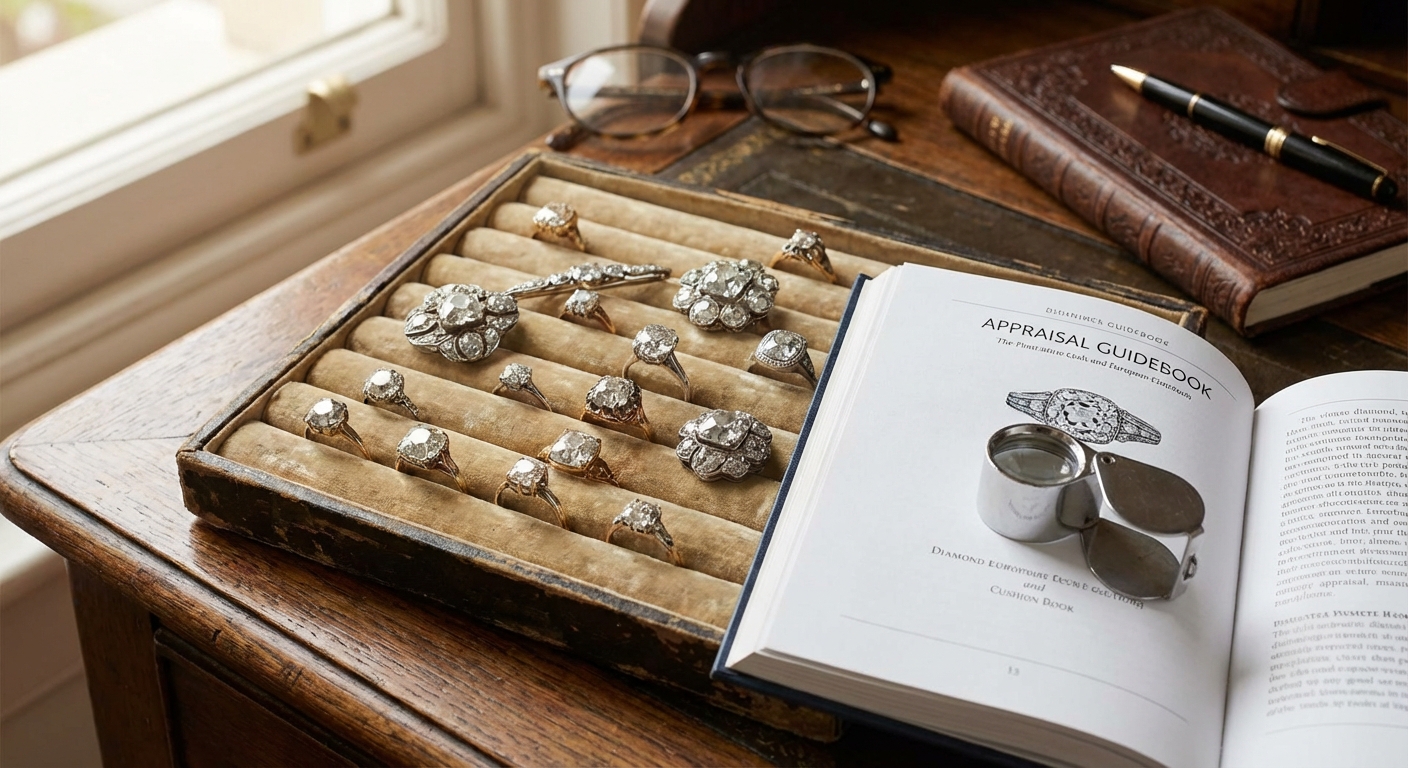
It’s always a pleasure when a client brings in a piece of jewelry they’ve inherited, perhaps a ring from a beloved grandmother, often tucked away for years, its true character obscured by time and changing fashions. They might see "just an old ring," but my eyes immediately begin to search for the subtle clues that tell a far richer story. Recently, a gentleman presented a platinum engagement ring, a family heirloom, assuming its central stone was a modern brilliant cut. However, with a loupe and a keen eye, it was clear that the diamond, while round, possessed the distinct personality of an Old European Cut, instantly elevating the piece from merely "old" to historically significant and intrinsically valuable.
Rediscovering the radiance of vintage diamonds is truly about understanding their unique cuts, which differ significantly from the precision-engineered diamonds of today. While I'm not a GIA certified gemologist, my decade of experience appraising jewelry, coupled with foundational gemstone and diamond courses, has taught me to appreciate these historical nuances. These older cuts were crafted to sparkle under candlelight, offering a broader, bolder flash rather than the intense, fragmented brilliance we associate with contemporary stones.
One of the most popular and recognizable vintage shapes is the Old European Cut (OEC), prevalent from the late 19th century through the Art Deco era. You'll often find these in Edwardian and Art Deco settings. Look for a small table facet, a high crown, a deep pavilion, and most notably, a distinct, often large, circular culet – that small facet at the bottom of the diamond. Their broad, chunky facets create a captivating "checkerboard" pattern of light and dark. Earlier still, from the Georgian and Victorian periods, we find the Old Mine Cut (OMC). These are often cushion-shaped, slightly squarer or more rounded than OECs, with even deeper pavilions and smaller tables, sometimes exhibiting slight asymmetry, reflecting a time before standardized cutting techniques. A less common but equally charming vintage cut is the Rose Cut, which lacks a pavilion entirely, featuring a flat base and a domed top covered in triangular facets. These were popular from the 16th to the 19th centuries, offering a subtle, ethereal shimmer rather than intense sparkle.
To truly appreciate and identify these treasures, here are a few strategies: First, examine the setting and metal. The style of the setting – intricate filigree, bold geometric lines, or ornate scrollwork – often provides a strong indication of the era and, by extension, the likely diamond cuts. Platinum, for instance, became popular in the early 20th century, often housing OECs. Second, observe the light play. Modern brilliant cuts are designed for intense sparkle. Vintage cuts, however, often display a softer, more romantic "glow" with broader flashes of color, a characteristic often called "fire." This difference in light interaction is a strong tell. Third, look for the tell-tale large culet using a jeweler's loupe. In modern diamonds, the culet is usually tiny or pointed, but in OMCs and OECs, it's a prominent, often visible, facet.
This appreciation for period correctness is a fundamental framework in appraisal. It’s about understanding how the diamond cut, metal, and setting align with the historical context, which significantly influences both authenticity and market value. Just last month, I appraised a stunning Art Nouveau pendant. The client was unaware the small diamonds were actually tiny, perfectly cut Old European Cuts, not modern single cuts, which meant the piece was entirely original to its era. This discovery reinforced its historical integrity and, consequently, its value as a true antique rather than a later assemblage.
If you suspect you possess a piece of vintage jewelry adorned with these unique diamond shapes, don't underestimate its potential. A qualified appraiser can meticulously identify these cuts, explain their historical significance, and provide an accurate, evidence-based valuation. Understanding the story behind your jewelry, from its era to its distinct diamond cuts, is the first step in truly rediscovering its enduring radiance and ensuring its legacy is properly recognized.