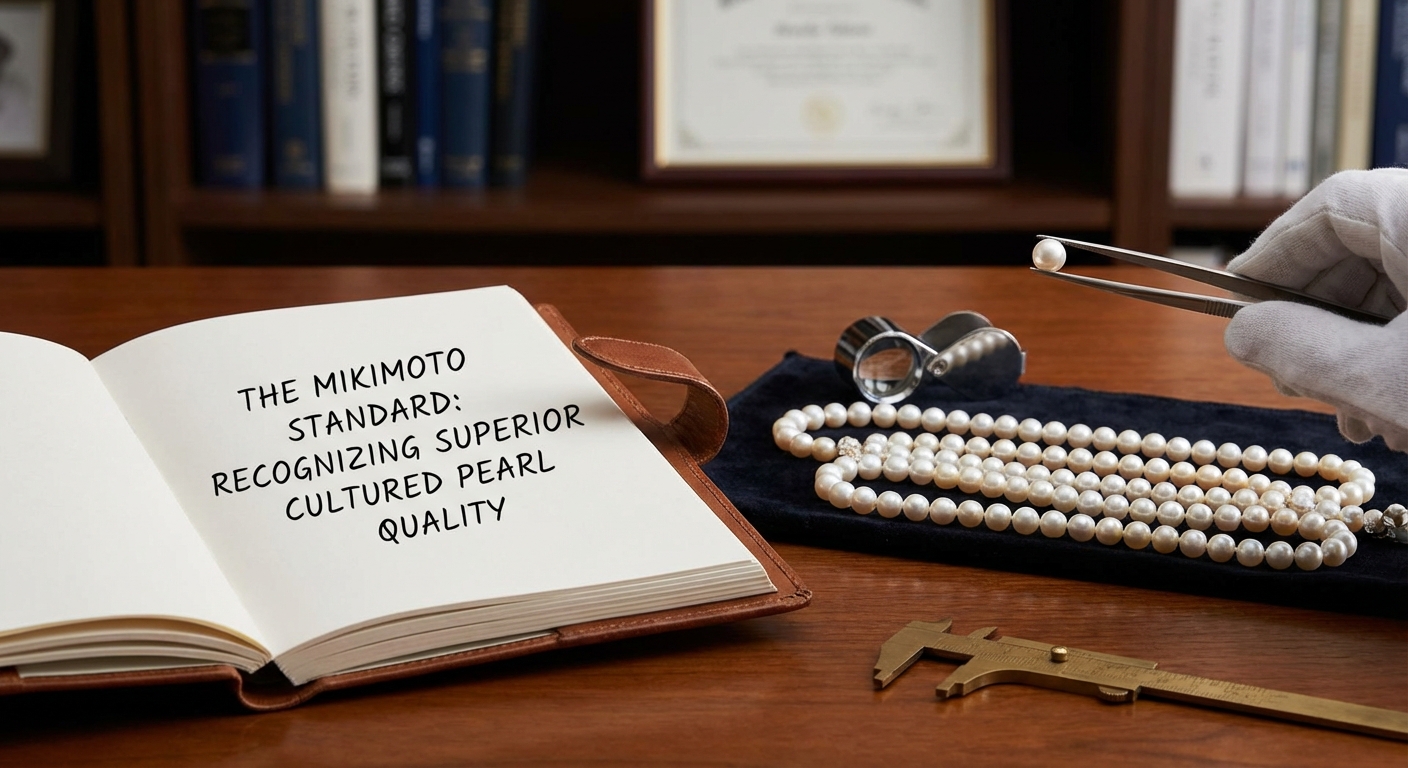
We’ve all seen it: the moment someone discovers a forgotten piece of jewelry, perhaps tucked away in an old box or inherited from a beloved aunt. They pull out a string of pearls, beautiful to the eye, perhaps even feeling substantial in the hand, and wonder, "Are these good pearls? Are they valuable?" It’s a common scenario, and often, the answer isn't immediately obvious. Many pearls are lovely, but only a select few embody the truly exceptional quality that sets them apart. This is where understanding the "Mikimoto Standard" becomes invaluable, not just as a brand benchmark, but as a universally recognized measure for superior cultured pearl quality.
When we talk about the Mikimoto Standard, we're referring to the exacting criteria established by Kokichi Mikimoto over a century ago. He didn't just create a brand; he pioneered an entire industry and set the bar for excellence. Even if a pearl doesn't bear the Mikimoto name, its quality can still be assessed against these rigorous standards. As an appraiser, I look for specific characteristics that elevate a pearl from merely attractive to truly remarkable.
One of the most critical factors is Luster. This isn't just about shine; it's the deep, inner glow that seems to emanate from within the pearl, combined with a sharp, mirror-like reflection on its surface. Imagine looking at a highly polished chrome bumper—you can see your own reflection clearly. A top-tier pearl will exhibit a similar crispness in its reflection. Pearls with excellent luster appear almost luminous, while those of lesser quality might look dull, chalky, or have a greasy sheen. To assess luster, hold the pearl under a direct light source and observe how clearly you can see the light source's reflection and the intensity of the pearl's glow.
Next, consider Surface Perfection. While pearls are natural creations, and a completely blemish-free surface is exceedingly rare, superior quality pearls will have very few, if any, noticeable imperfections to the naked eye. We're looking for an absence of pits, bumps, circles, or wrinkles. Minor surface characteristics might be acceptable if they are few and far between, and do not detract from the pearl's overall beauty or durability. Run your finger gently over the surface; it should feel smooth and uniform.
Finally, we examine Nacre Thickness and Matching. Nacre is the iridescent substance that forms the pearl, and its thickness directly correlates with a pearl's luster, durability, and overall beauty. Thicker nacre results in a richer, deeper luster and greater resilience. While measuring nacre thickness typically requires specialized equipment, you can often infer it by observing the pearl's luster and weight relative to its size. A pearl with thin nacre might appear duller or have a "chalky" look, and over time, the bead nucleus might even show through. For strands, matching is paramount. The pearls should be uniform in size, shape, color, and luster throughout the entire strand. This consistency is a hallmark of high-quality pearl jewelry. The "5 Virtues" of pearls – Luster, Surface, Shape, Color, and Size – provide a comprehensive framework for evaluation, with nacre thickness often considered a key component influencing these virtues.
In practice, this often plays out when comparing two seemingly similar pearl necklaces. I once had a client bring in two strands, both beautiful, both family heirlooms. One had a lovely, soft glow, but the other, while appearing similar in size, had an almost electric luster; it seemed to capture and reflect all available light, and its surface was remarkably clean. That second strand, though not explicitly a Mikimoto, exemplified the Mikimoto Standard, showcasing superior nacre thickness and exceptional luster that immediately elevated its value significantly.
Understanding these aspects helps you appreciate the true artistry and natural wonder behind fine pearls. However, for a precise valuation for insurance, estate planning, or sale, recognizing these qualities is only the first step. An objective, professional appraisal by a certified personal property appraiser like myself, with specialized knowledge in jewelry, is crucial to accurately determine the true market value of your treasured pearls. We can identify subtle nuances and provide the documented analysis you need.