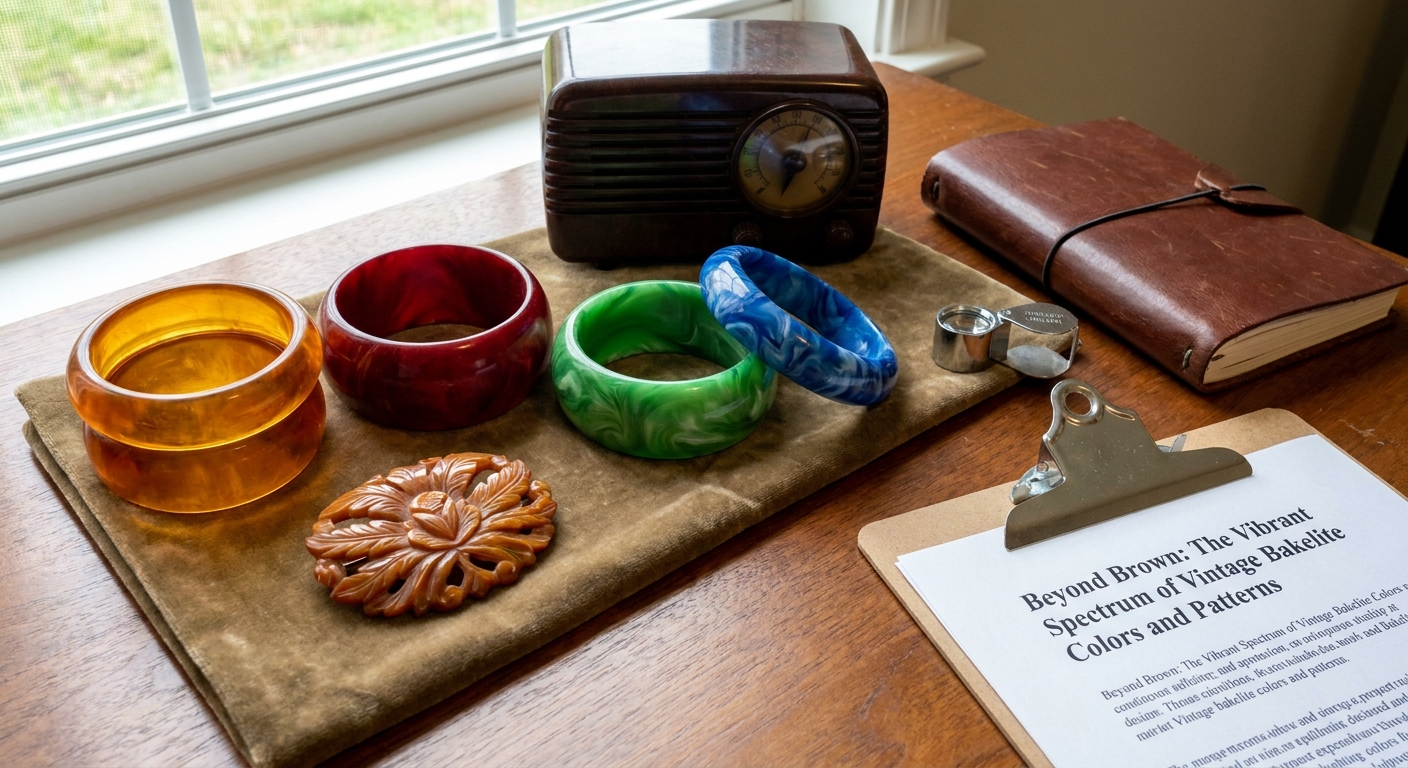
It's a familiar scene: a client brings in a shoebox of inherited jewelry, often dismissing a chunky bracelet or a collection of seemingly ordinary pins as "just old plastic." They might mention a piece is "brown, like grandma always wore," or "a dull green bangle," assuming its age and material dictate a minimal value. It’s a common misconception that vintage Bakelite, a groundbreaking early plastic, is limited to a palette of dark, utilitarian hues. But to truly appreciate and value these pieces, we must look beyond the initial impression and delve into the surprisingly vibrant and diverse spectrum of colors and patterns Bakelite offered.
Bakelite, patented in 1907 by Leo Baekeland, was initially celebrated for its durability and insulating properties. While early industrial applications did favor darker, more subdued tones like black, brown, and dark green, its adoption in fashion and decorative arts in the 1920s and 30s sparked an explosion of color. Designers quickly realized its potential, transforming it into jewelry, radios, and household items that captured the spirit of the era. The range is astonishing, from the classic "apple juice" (a translucent golden yellow) and "butterscotch" to vivid cherry reds, emerald greens, cobalt blues, and even highly sought-after true pinks.
One of the first strategies in evaluating Bakelite is to understand its true color potential, even when obscured by age. Bakelite can develop a patina over time, especially lighter colors, which might make a piece appear darker or duller than its original state. For instance, an "apple juice" bangle might look like a dark amber until carefully cleaned, revealing its translucent golden glow. Similarly, a piece that seems olive green might actually be a vibrant forest green, or even a chartreuse, beneath a layer of surface oxidation. This isn't damage; it's a characteristic of the material, but recognizing the underlying hue is crucial for accurate assessment.
Beyond solid colors, a second key strategy involves identifying the myriad patterns and decorative techniques. Bakelite was not just molded; it was carved, laminated, painted, and inlaid. Look for deeply carved floral motifs, geometric designs, or whimsical figural elements. Laminated pieces, often called "poker chip" or "sandwich" Bakelite, feature layers of contrasting colors fused together, creating striking visual interest. Examples include red and black stripes, green and yellow checks, or elaborate zigzags that elevate a simple form into a collector's dream. These intricate patterns and carvings significantly increase a piece's desirability and, consequently, its value.
A practical step, before diving deep into color and pattern, is to confirm the material itself. While I'm not a GIA certified gemologist, my experience with materials like Bakelite means I often employ the Simichrome test. Applying a tiny amount of Simichrome polish to an inconspicuous spot on the piece with a cotton swab will reveal a yellow residue if it's true Bakelite, due to a reaction with the formaldehyde. This simple test confirms authenticity, allowing us to then focus on its aesthetic merits.
In practice, I once appraised a collection of bangles from an estate. Most were common browns and blacks, but one, initially dismissed by the family as "just another dark one," caught my eye. Upon closer inspection, and after a gentle cleaning, its true nature emerged: a rare, deeply marbled Bakelite bangle with swirls of vibrant orange, deep red, and streaks of black. The interplay of these colors, combined with an uncommon chunky profile, transformed it from a forgotten curio into a significant piece for an avid collector. This illustrates how the "Condition, Rarity, Desirability" framework applies directly: its excellent condition, rare marbled pattern (rarity), and unique color combination (desirability) dramatically impacted its valuation.
Never underestimate the hidden beauty in "old plastic." What appears to be a mundane brown or green piece could, upon closer inspection, reveal a rich, vibrant history of color and design. For anyone holding what they suspect might be vintage Bakelite, do not dismiss it. Its true value often lies beyond the surface. Consulting an experienced personal property appraiser is essential to accurately identify, understand, and value these fascinating pieces, ensuring their unique story and worth are properly recognized.