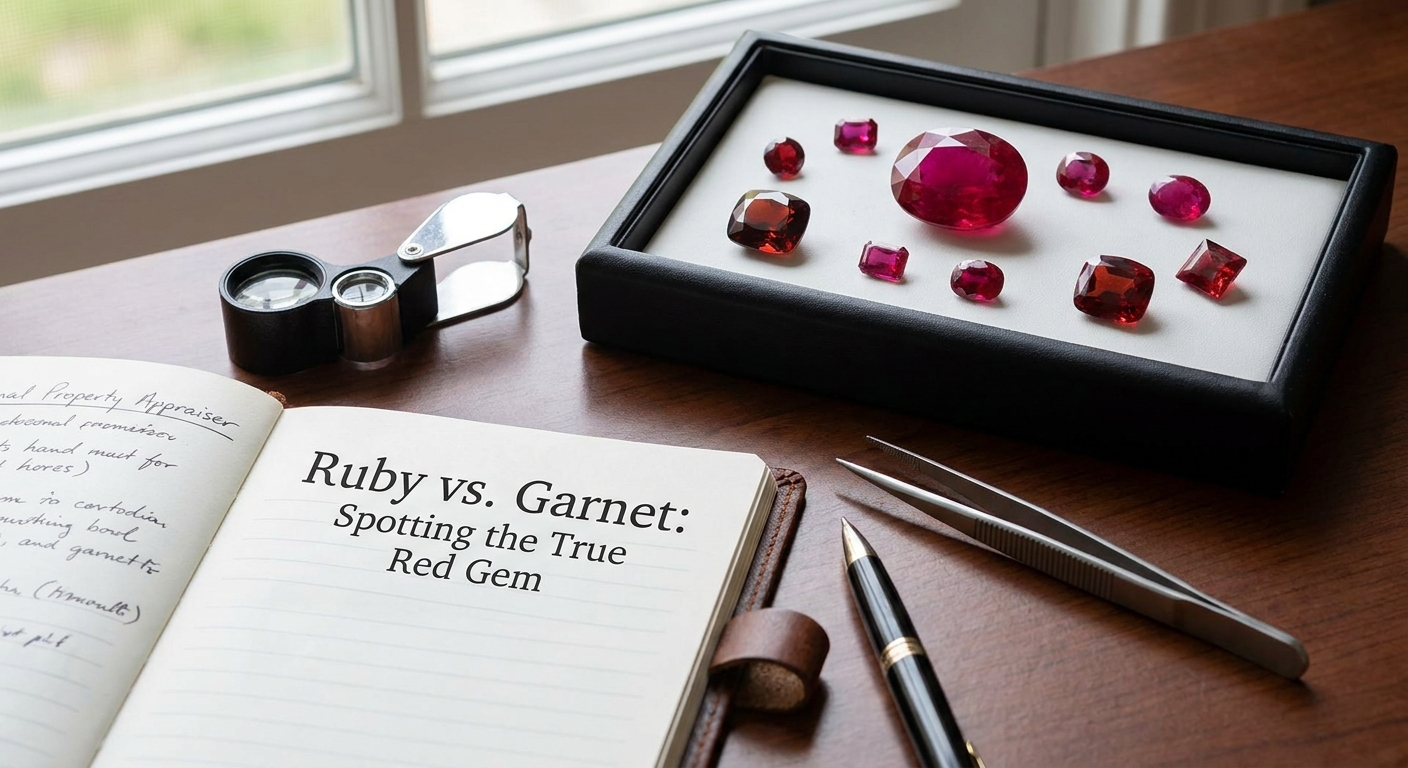
Imagine someone excitedly bringing in a vintage cocktail ring, a family heirloom, the centerpiece a deep, fiery red stone. "This is my grandmother's ruby," they declare, their voice brimming with pride and anticipation. It's a common scenario in my appraisal practice, and one that highlights the fascinating, sometimes challenging, world of gem identification. While the emotional value of such a piece is undeniable, determining its true gemological identity is where my expertise comes in. Often, what appears to be a ruby might, upon closer inspection, reveal itself to be a beautiful garnet – a distinction that carries significant implications for both monetary value and historical context.
Distinguishing between a ruby and a garnet isn't always straightforward, especially to the untrained eye, as both can present in stunning shades of red. However, there are several key indicators and strategies I employ, even before considering advanced lab testing, that can help differentiate these captivating gems.
First, visual inspection under various light sources is crucial. Rubies, a variety of the mineral corundum, are renowned for their intense, often fluorescent red, sometimes described as "pigeon's blood." Many natural rubies, particularly those from certain origins like Myanmar (Burma), exhibit a strong red fluorescence under ultraviolet (UV) light, which gives them an almost internal glow. Garnets, a group of silicate minerals, typically lack this fluorescence; their red hues, while equally beautiful, tend to be more stable and less reactive to UV light, often appearing a deeper, sometimes brownish or purplish red. Observing how the stone reacts to different light, especially shortwave and longwave UV, provides a significant clue.
Second, I pay close attention to the stone's physical characteristics and inclusions under magnification. Rubies are significantly harder (9 on the Mohs scale) than garnets (6.5-7.5). This difference in hardness can sometimes be subtly observed in the wear patterns on older pieces. Under a loupe, a ruby might display characteristic "silk" inclusions – fine, needle-like rutile crystals – or growth zoning. Garnets, while often appearing remarkably clean, can exhibit different types of inclusions. While I am not a GIA certified gemologist, my extensive experience and specialized training allow me to recognize these tell-tale signs, which then guide further investigation.
Third, consider the overall brilliance and fire. While both gems are beautiful, rubies, due to their higher refractive index and often excellent cut, can exhibit a more pronounced brilliance and "fire" – the dispersion of light into spectral colors. Garnets can be very brilliant too, but often have a slightly different optical character, sometimes appearing a bit more vitreous or glassy. It's a subtle difference that becomes clearer with experience.
In my practice, I often lean on the "Principle of Least Assumption." This means I never assume a stone's identity based solely on its color or a client's belief. Every identification begins with objective observation and methodical testing. This framework ensures that personal biases or pre-conceived notions don't influence the appraisal, leading to accurate and reliable conclusions.
Just last month, I was evaluating a stunning antique necklace featuring a large, vibrant red stone. The owner was convinced it was a high-quality garnet, given its age and the common use of garnets in that period. However, during my initial visual assessment, I noticed a subtle, almost electric red glow that hinted at something more. A quick check under the UV lamp confirmed my suspicion: a strong, unmistakable red fluorescence. With further examination and testing, it was confirmed to be a natural ruby, significantly elevating the piece's appraised value and providing the owner with a delightful surprise and a deeper appreciation for their family treasure.
The world of red gems is rich and varied, and while these strategies offer valuable insights, distinguishing a ruby from a garnet often requires specialized knowledge and equipment. For anyone holding a cherished red gemstone, particularly one with sentimental or potential monetary value, my strongest advice is this: do not rely on guesswork or online speculation. Seek out a certified personal property appraiser with expertise in jewelry. They possess the tools, training, and experience to accurately identify your gem, ensuring you understand its true nature and value. It’s an investment in knowledge that truly pays off.