Imagine inheriting a beautiful antique ring, its central stone shimmering with an otherworldly dance of colors. You know it's an opal, but is it a family heirloom of significant value, or a charming piece with primarily sentimental worth? This is a common scenario for many clients, a moment of discovery often tinged with curiosity about what makes their particular opal unique. Opals, with their captivating play-of-color, are among the most enigmatic and personal of gemstones, each one a miniature universe of light.
What gives opals their extraordinary allure is their unique internal structure, allowing them to diffract light into a spectrum of colors – a phenomenon known as "play-of-color." Unlike faceted diamonds or sapphires, an opal’s beauty lies in this fluid, dynamic display. While all opals share this fundamental characteristic, their appearance, origin, and value vary wildly depending on their type, with black, white, and boulder opals representing three distinct categories often encountered in jewelry.
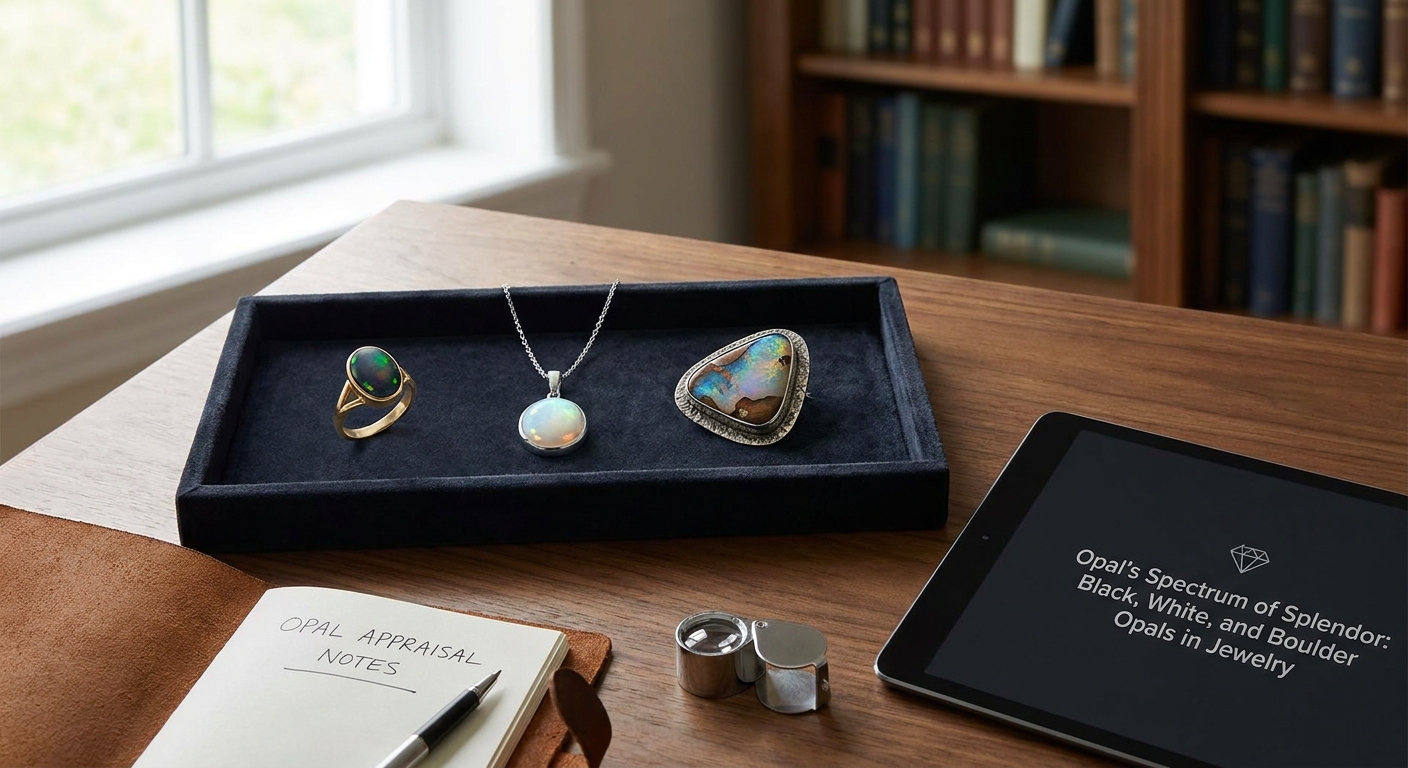
Black opals, primarily sourced from Australia's Lightning Ridge, are arguably the most prized. Their dark body tone, ranging from a dark grey to jet black, provides a dramatic contrast that makes their vibrant flashes of red, green, blue, and orange truly pop. This deep background allows the play-of-color to appear exceptionally brilliant and intense, making them highly sought after for high-end jewelry. Their rarity contributes significantly to their value.
In contrast, white opals, also known as light opals, feature a translucent to opaque light body tone – white, yellow, or light grey. While still beautiful, their lighter background often means the play-of-color can appear more pastel or subdued compared to their darker counterparts. Found predominantly in South Australia, white opals are more common and, consequently, generally less valuable per carat than black opals, though large, vibrant examples can still be quite striking.
Boulder opals offer a fascinating blend of the opal and its host rock, typically ironstone or sandstone. These Australian opals are cut with a layer of the natural rock matrix left on the back, or sometimes through the face, creating unique patterns and adding strength. The opal seam itself can be quite thin, but because it's backed by the dark host rock, boulder opals often exhibit a brilliant play-of-color similar to black opals, making them a popular and often more affordable alternative. Their organic shapes and earthy tones lend themselves beautifully to bespoke and contemporary designs.
When evaluating an opal, several strategies come into play. First, examine the body tone and play-of-color intensity. A darker body tone (for black opals) or a vibrant, broad-flash pattern (for any opal) indicates higher quality. Look for a full spectrum of colors visible from multiple angles. Second, consider the opal's pattern and brightness. Patterns like "harlequin," "pinfire," or "flash" influence desirability, and the overall brightness of the color play is crucial. A dull opal, no matter the pattern, holds less value. Finally, assess the overall integrity and setting. Are there any cracks or crazing (tiny surface cracks)? Is it a solid opal, or a doublet/triplet (a thin slice of opal backed by another material or capped with clear quartz)? The metal type and craftsmanship of the setting also contribute to the piece's overall value and aesthetic appeal.
The principle of rarity and market demand is particularly evident with opals. A magnificent black opal with a vibrant broad-flash pattern from Lightning Ridge, for example, will command a significantly higher price than a common white opal of similar size, simply due to its scarcity and desirability among collectors and connoisseurs.
Just last month, I appraised an early 20th-century pendant for a client. She believed it was a solid white opal, a family piece. Upon closer inspection, it was a beautifully crafted triplet, a thin slice of opal backed and capped to enhance its appearance. While still a lovely and sentimental piece, understanding this distinction was vital for an accurate valuation and for managing the client's expectations regarding its market value.
Understanding the nuances between black, white, and boulder opals is essential for anyone appreciating or investing in these remarkable gems. Each type possesses its own charm and market position. If you have an opal piece and wish to understand its specific type, quality, and current market value, a professional appraisal is invaluable. It provides clarity and peace of mind, ensuring you fully appreciate the unique spectrum of splendor your opal holds.