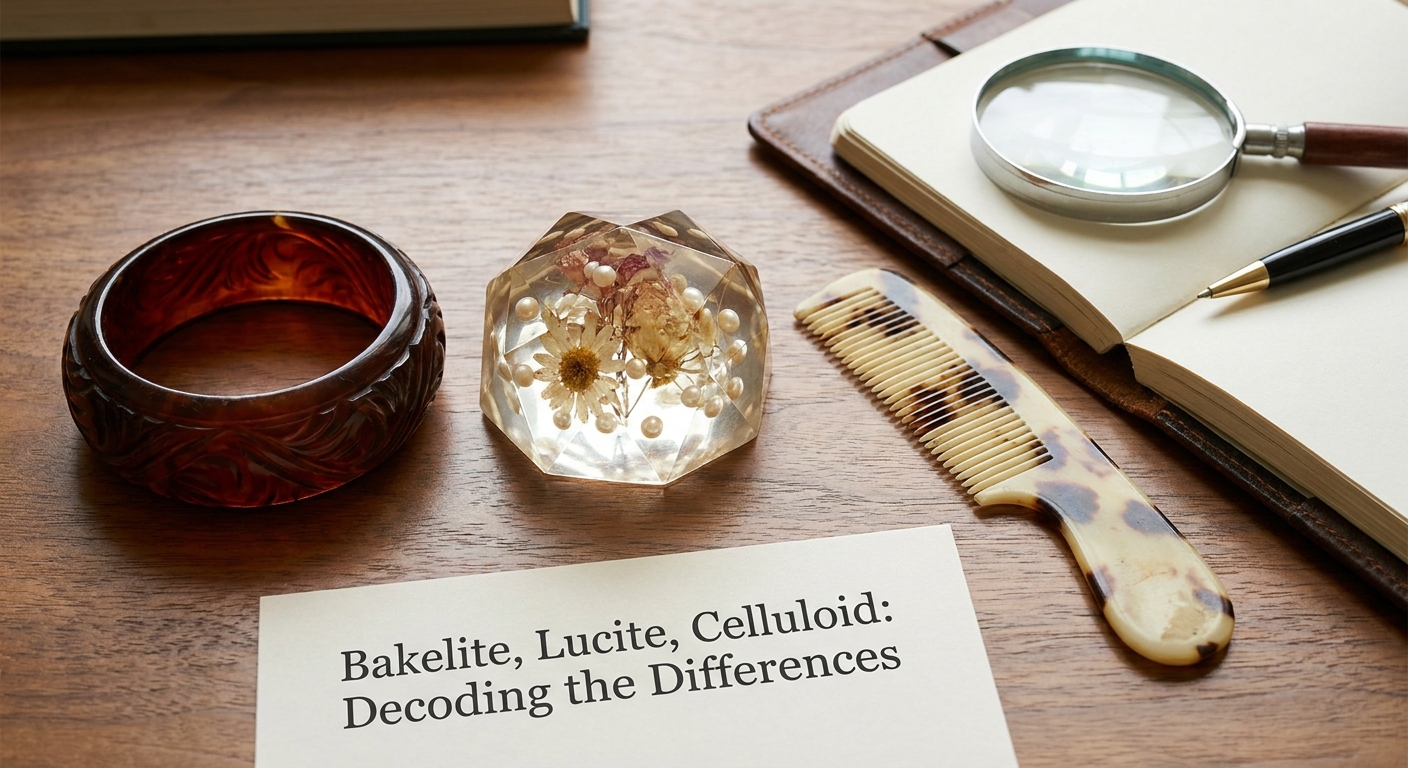
It’s a scenario I encounter regularly: a client brings in a collection of what they assume is costume jewelry, perhaps inherited from a grandmother, describing it simply as "plastic." They might have a box filled with chunky bangles, colorful brooches, or whimsical earrings, often dismissing their value outright. Sometimes, tucked among more modern pieces, there's a bracelet with a distinctive heft, a rich, deep color, or a subtle patina that immediately catches my eye. This is where the detective work begins, distinguishing between early, historically significant plastics like Bakelite, Lucite, and Celluloid, and their less valuable modern counterparts.
Understanding these materials isn't just about identifying a specific type of plastic; it's about recognizing a piece of design history and, often, significant market value. While they may look similar at first glance, each material possesses unique characteristics that, once understood, make identification surprisingly straightforward.
One of the most reliable strategies for identifying Bakelite is the Simichrome test. Bakelite, a thermosetting phenol formaldehyde resin, was patented in 1907 and widely used for everything from radios to jewelry. To perform the test, apply a tiny dab of Simichrome polish (a common metal polish) to a cotton swab and rub it gently on an inconspicuous spot on the item. If the swab turns yellow, the piece is Bakelite. This reaction is due to the oxidation of the Bakelite surface, and it's a non-damaging test if done sparingly and wiped clean immediately. I’ve seen clients' eyes widen in surprise when a seemingly ordinary bangle reveals its true identity and potential value through this simple process.
For Celluloid, an early thermoplastic material developed in the mid-19th century, the key lies in its unique odor. The hot water/smell test is often effective, though it requires caution. Briefly dip a small, inconspicuous part of the item into hot (not boiling) water for a few seconds. Immediately after, smell the warmed area. Celluloid, made from nitrocellulose and camphor, will emit a distinct camphor-like scent, often described as smelling like Vicks VapoRub. Be extremely careful with this material, as Celluloid is highly flammable, which is why its use declined significantly after Bakelite's introduction. Always ensure good ventilation and only use a small, non-critical area for the test.
Distinguishing Lucite, a transparent acrylic resin introduced in the 1930s, often relies more on visual and tactile cues. Lucite is generally lighter than Bakelite and tends to have a glassier, more brilliant finish. It was frequently used for clear, carved pieces, or items with embedded objects, a characteristic rarely seen in Bakelite. When I hold a piece of Lucite, I notice its smooth, often cool feel and its characteristic "clacky" sound when tapped against another piece of Lucite or Bakelite. This focus on sensory input—sight, touch, and even sound—is a critical aspect of material identification, a practical application of understanding the differing polymer structures and densities.
I recall an appraisal where a client had a collection of what she believed were inexpensive plastic bangles from the 1970s. While most were indeed modern plastics, one particularly vibrant green bangle felt heavier and produced a satisfying, dense clack when gently tapped. A quick Simichrome test confirmed it was Bakelite. The client was thrilled; what she thought was a novelty piece turned out to be a valuable example of early plastic jewelry, commanding a significantly higher market value than she had ever imagined.
Ultimately, while these tests provide excellent starting points, the subtle nuances and variations across different eras and manufacturers can be complex. If you've inherited or acquired pieces that you suspect might be early plastics, don't just assume they're "cheap plastic." Their history, craftsmanship, and rarity can make them surprisingly valuable. A professional appraiser with specialized knowledge in these materials can accurately identify your pieces, provide a clear understanding of their condition, and determine their current market value, ensuring you receive a comprehensive and informed assessment.