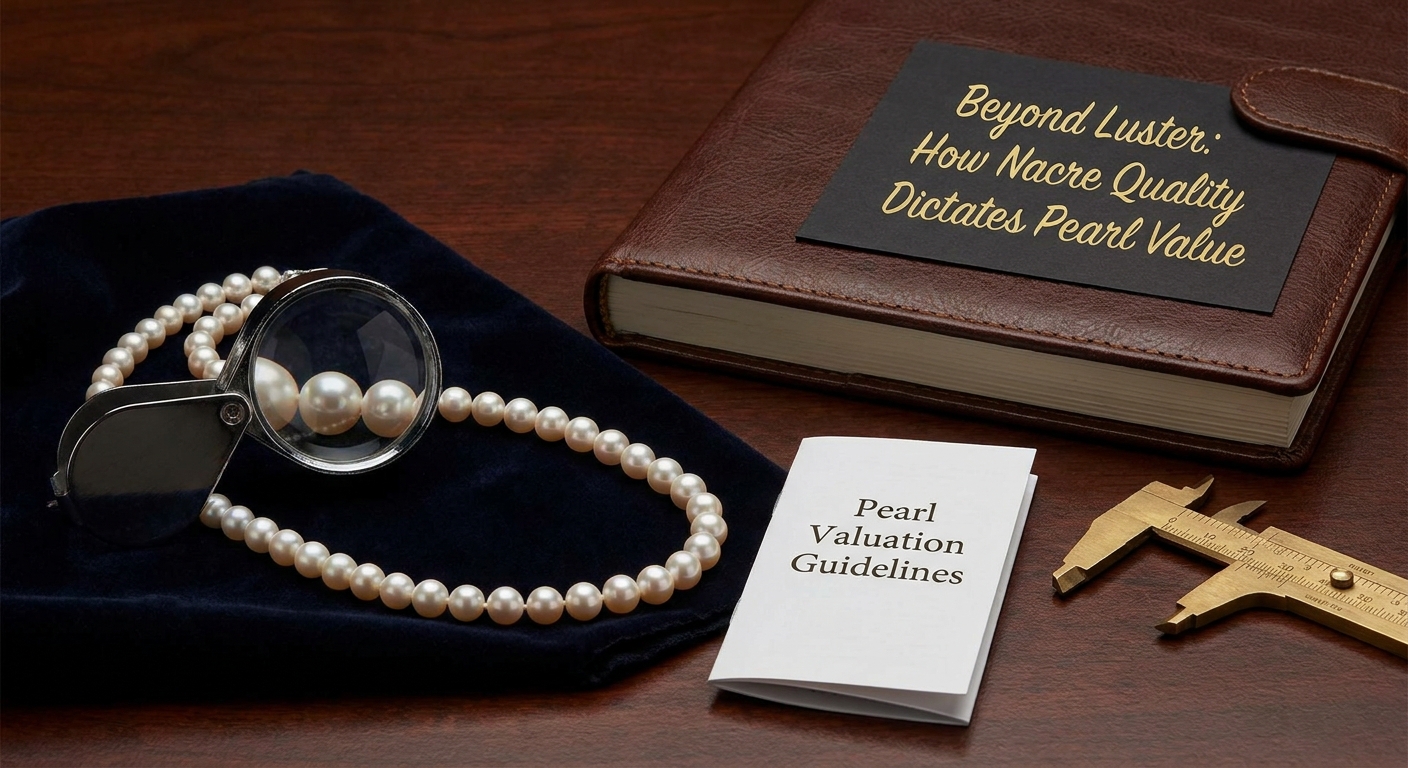
It’s a common scenario: a client brings in a beautiful pearl necklace, a family heirloom, perhaps worn lovingly for decades. On the surface, the pearls possess a lovely glow, a soft, inviting luster. The client, naturally, expects a significant valuation, often based on sentimental value and initial visual appeal. However, as an appraiser, my task is to look beyond that initial charm, to delve into the subtle nuances that truly dictate a pearl’s worth. More often than not, it's the hidden story within the nacre – the very substance that forms the pearl – that ultimately determines its market value, sometimes surprising even the most discerning eye.
Nacre, the iridescent organic-inorganic composite material produced by mollusks, is the pearl’s lifeblood. It’s composed of microscopic layers of aragonite crystals and conchiolin, meticulously laid down over time. This layering process isn't just about creating beauty; it’s fundamental to the pearl's durability, its unique optical phenomena, and ultimately, its value. Understanding nacre quality means looking beyond surface-level shine and delving into its thickness, uniformity, and the way it interacts with light.
One critical strategy in assessing pearl value is evaluating nacre thickness. Thin nacre is a significant detractor. Over time, thin nacre can wear away, exposing the bead nucleus underneath, a phenomenon sometimes referred to as "beading." You might see a dull, chalky spot or even the distinct outline of the bead through the outer layer. To check this, I meticulously examine the pearl, often rotating it under various light sources, paying close attention to the drill holes where the nacre tends to be thinnest. A robust, thick nacre layer not only ensures the pearl’s longevity but also contributes to its deep, rich luster and orient.
Another key area is assessing the uniformity and smoothness of the nacre layers. While surface blemishes like pits or bumps are easily visible, the subtle imperfections in the nacre's layering can also significantly impact luster and overall appeal. I look for consistent light reflection across the entire surface. Wrinkles or unevenness in the nacre, even if not immediately obvious, can create a less vibrant, more diffused luster. A truly high-quality pearl will exhibit a consistent, sharp reflection of light, a testament to its smooth, finely layered nacre.
Finally, while "luster" is often the first word that comes to mind with pearls, it's essential to distinguish between surface shine and true orient, which is a direct consequence of exceptional nacre quality. Luster is the reflective quality of the pearl's surface. Orient, however, is the iridescent, rainbow-like shimmer that appears to emanate from within the pearl itself. This effect is caused by the diffraction of light through multiple, extremely thin, uniform layers of nacre. A pearl with superior nacre will exhibit both high luster and a pronounced orient, creating a captivating visual depth.
In practice, I often refer to the comprehensive criteria for pearl valuation, where nacre quality is recognized not just as a distinct factor, but as a foundational element influencing several other value determinants like luster, durability, and surface quality. Just last month, I appraised two Akoya pearl necklaces, both seemingly of similar size and luster. One had visibly thicker, more uniform nacre, resulting in a deeper, more consistent orient. The other, despite good initial shine, showed subtle "beading" near the drill holes, indicating thinner nacre. This difference significantly impacted their respective valuations, underscoring the hidden depth of nacre's influence.
The true beauty and value of a pearl extend far beyond its initial captivating gleam. It lies in the intricate, often unseen, quality of its nacre. For anyone holding a significant pearl piece, whether an inherited treasure or a new acquisition, understanding its true value requires more than a casual glance. It demands the trained eye of an experienced appraiser who can meticulously evaluate these intricate details, ensuring you receive an accurate and comprehensive understanding of your pearl’s worth. Don't let superficial beauty mask the true story of your pearls; seek professional insight to unveil their complete value.