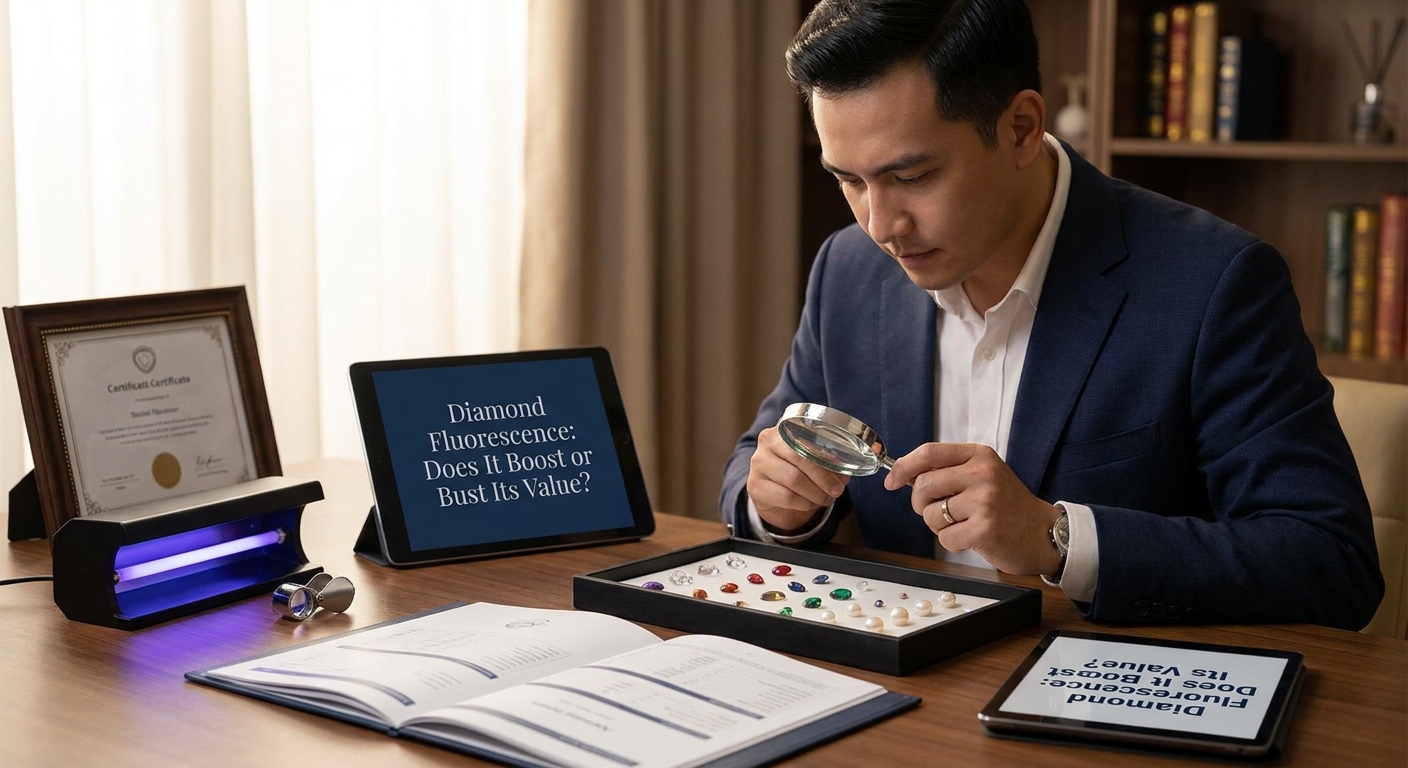
I recently had a client bring in a beautiful estate diamond ring, a family heirloom passed down through generations. She was beaming, convinced she had a truly exceptional piece. However, a local jeweler, while admiring its beauty, had mentioned in passing that the diamond had "strong blue fluorescence," leaving her confused and worried that this might significantly diminish its value. Her excitement had turned to apprehension, a common scenario when clients encounter this often-misunderstood characteristic.
Diamond fluorescence is a natural phenomenon where a diamond emits a visible light, most commonly blue, when exposed to ultraviolet (UV) light. Approximately 25% to 35% of all diamonds exhibit some degree of fluorescence, which the GIA grades as None, Faint, Medium, Strong, or Very Strong. The question of whether this property enhances or detracts from a diamond's value is one that frequently arises in appraisals and in the broader jewelry market.
For the vast majority of diamonds, fluorescence has absolutely no discernible impact on their appearance or value. This is a crucial point many consumers miss. The GIA, after extensive research, concluded that for most diamonds, the presence of fluorescence does not affect transparency or color appearance when viewed under normal lighting conditions.
However, there are specific instances where fluorescence can play a role, either positively or negatively. In a small percentage of diamonds, typically those with Strong to Very Strong fluorescence, particularly in higher color grades (D through H), the fluorescence can cause the stone to appear hazy, milky, or oily. This visual haziness, though rare, can indeed negatively impact the diamond's beauty and, consequently, its market value. Conversely, in diamonds with lower color grades (I through M), strong blue fluorescence can actually be beneficial. The blue tint can counteract the slight yellow body color, making the diamond appear whiter and brighter than it would without fluorescence. In these cases, it might even command a slight premium or at least not incur a discount.
When evaluating a diamond with fluorescence, my approach is always practical and visual. Here are a few strategies I employ:
First, prioritize visual assessment over the report grade alone. A GIA report might state "Strong Blue" fluorescence, but it’s imperative to examine the diamond in person under various lighting conditions. Does it look milky or hazy? If not, the fluorescence is likely benign. I’ve seen countless diamonds with strong fluorescence that are utterly brilliant and clear.
Second, understand the interplay with the diamond’s color grade. As mentioned, strong blue fluorescence in a D-H color diamond warrants careful inspection for haziness. Yet, that same strong blue fluorescence in an I-M color diamond might actually enhance its perceived color, making it a more attractive option for some buyers. This nuanced understanding is key.
Third, seek an experienced, independent appraisal. A certified appraiser can provide an objective evaluation, considering all factors including the diamond’s cut, clarity, color, and carat weight, alongside the visual impact of any fluorescence. This holistic approach ensures an accurate valuation.
Just last month, I was appraising a stunning vintage engagement ring. The client had a GIA report indicating "Medium Blue" fluorescence. She was worried, having read online forums suggesting any fluorescence was a flaw. However, upon careful examination under natural daylight and various indoor lights, the diamond showed no signs of haziness or oiliness. It was vibrant and crisp, its beauty completely unaffected. My appraisal reflected its true visual quality, not just a line item on a report.
Ultimately, don't let the term "fluorescence" alone dictate your perception of a diamond's value. Its presence isn't inherently good or bad; its impact depends entirely on how it visually manifests in that specific stone. For an accurate and unbiased understanding of your diamond's true market value, always consult with a certified personal property appraiser who can provide an expert, in-person evaluation.