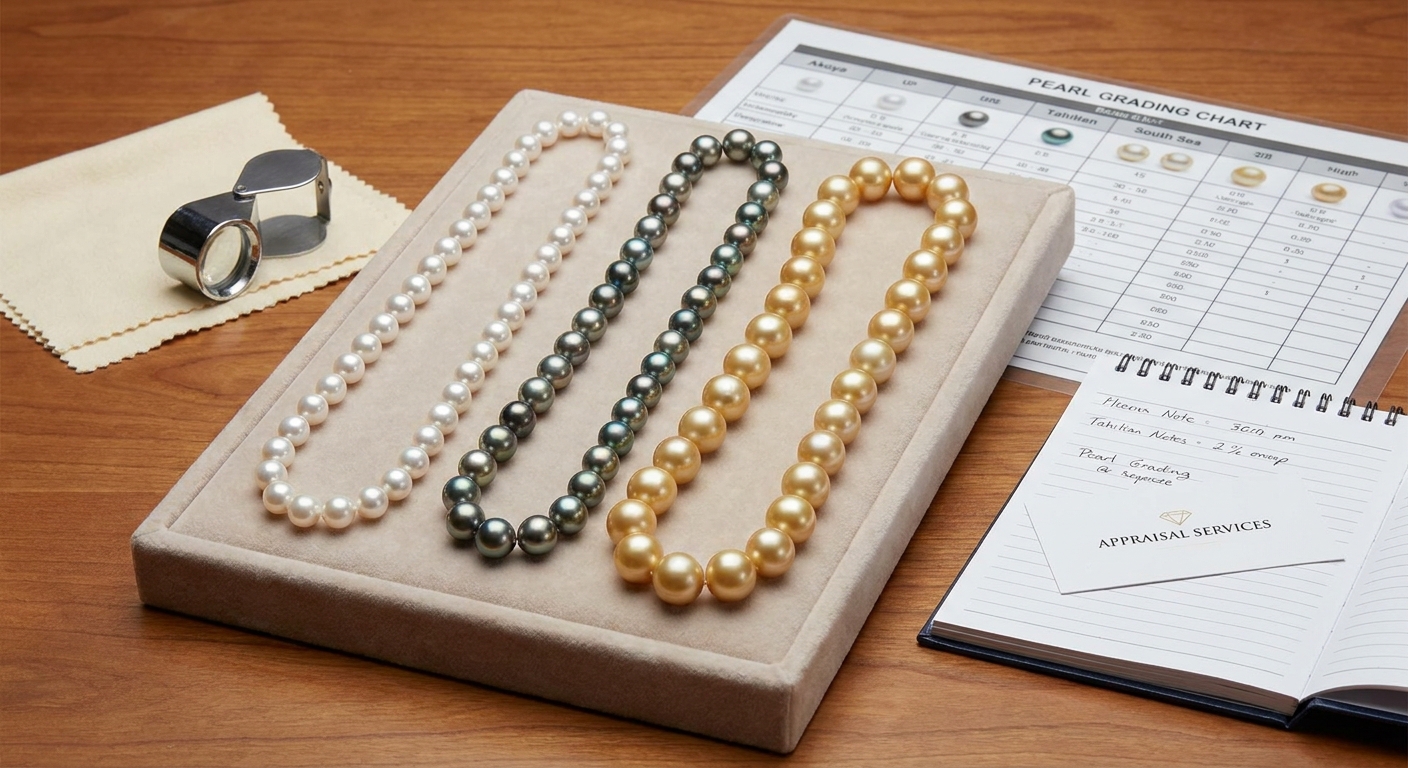
A client recently brought in a strand of pearls, a treasured inheritance. She knew they were old, beautiful even, but beyond that, their story was a mystery. Were they the classic Akoyas her grandmother spoke of, or something more exotic? This scenario is incredibly common. The world of pearls, with its shimmering diversity, often leaves people perplexed. As an appraiser, one of the most frequent questions I encounter is simply, "What kind of pearls are these?" Understanding the fundamental differences between Akoya, Tahitian, and South Sea pearls is key, not just for identification, but for appreciating their unique beauty and value.
When I’m evaluating a piece, I approach pearl identification by focusing on a few critical visual cues. It’s a bit like being a detective, looking for distinguishing features.
First, size is often the most immediate giveaway. Akoya pearls, primarily cultivated in Japan, are typically the smallest of the three, ranging from about 2mm to 10mm. They are the quintessential "classic" pearl, often found in elegant, uniform strands. Tahitian pearls, originating from French Polynesia, are noticeably larger, usually between 8mm and 16mm. Then we have South Sea pearls, cultivated in Australia, Indonesia, and the Philippines, which are the giants of the pearl world, commonly ranging from 9mm to a remarkable 20mm or more. If you have a pearl the size of a blueberry, it’s highly unlikely to be an Akoya.
Next, color provides crucial clues. Akoyas are renowned for their crisp, bright luster and classic white, cream, or silver-pink hues, often with subtle rose or silver overtones. They embody that timeless, elegant look. Tahitian pearls, in stark contrast, are famous for their exotic, dark body colors, often referred to as "black pearls." However, their palette is surprisingly rich, encompassing various shades of grey, green (peacock), blue, purple, and even brown. South Sea pearls offer a spectrum of their own, primarily in white, silver, and the highly prized golden tones. Their colors tend to be softer, more satiny than the sharp luster of an Akoya.
Finally, luster and surface characteristics help refine the identification. Akoyas are celebrated for their exceptionally high, mirror-like luster – a sharp reflection that seems to glow from within. South Sea pearls, while still lustrous, often have a softer, more satiny sheen, almost like velvet. Their nacre is typically very thick, contributing to this unique glow and often leading to fewer surface blemishes compared to their size. Tahitian pearls can display a wide range of luster, from metallic to soft, and often exhibit unique iridescent "orient" (a rainbow-like shimmer on the surface). All pearls, being natural products, will have some surface imperfections, often called "blemishes" or "birthmarks." The type and extent of these can also offer hints, but are more relevant to grading than initial identification.
Think of these characteristics – size, color, and luster/surface – as key components within a broader framework, like the "7 Pearl Value Factors" (size, shape, color, luster, surface quality, nacre thickness, and matching). While all contribute to value, these specific three are particularly helpful for initial identification.
Just last month, I was examining a striking single pearl pendant. Its dark, almost metallic green hue was immediately captivating, and at 13mm, it was certainly substantial. The overtone shifted beautifully in the light, a tell-tale sign of a Tahitian. The subtle rings on its surface, while not detracting from its beauty, confirmed its natural origin within the Tahitian family.
Demystifying pearl identification truly comes down to understanding these defining traits. If you find yourself wondering what treasures you hold, remember that professional insight offers clarity and peace of mind. A qualified appraiser can help identify your pearls, explain their unique characteristics, and provide a comprehensive valuation, ensuring you understand the full story and worth of your cherished possessions.