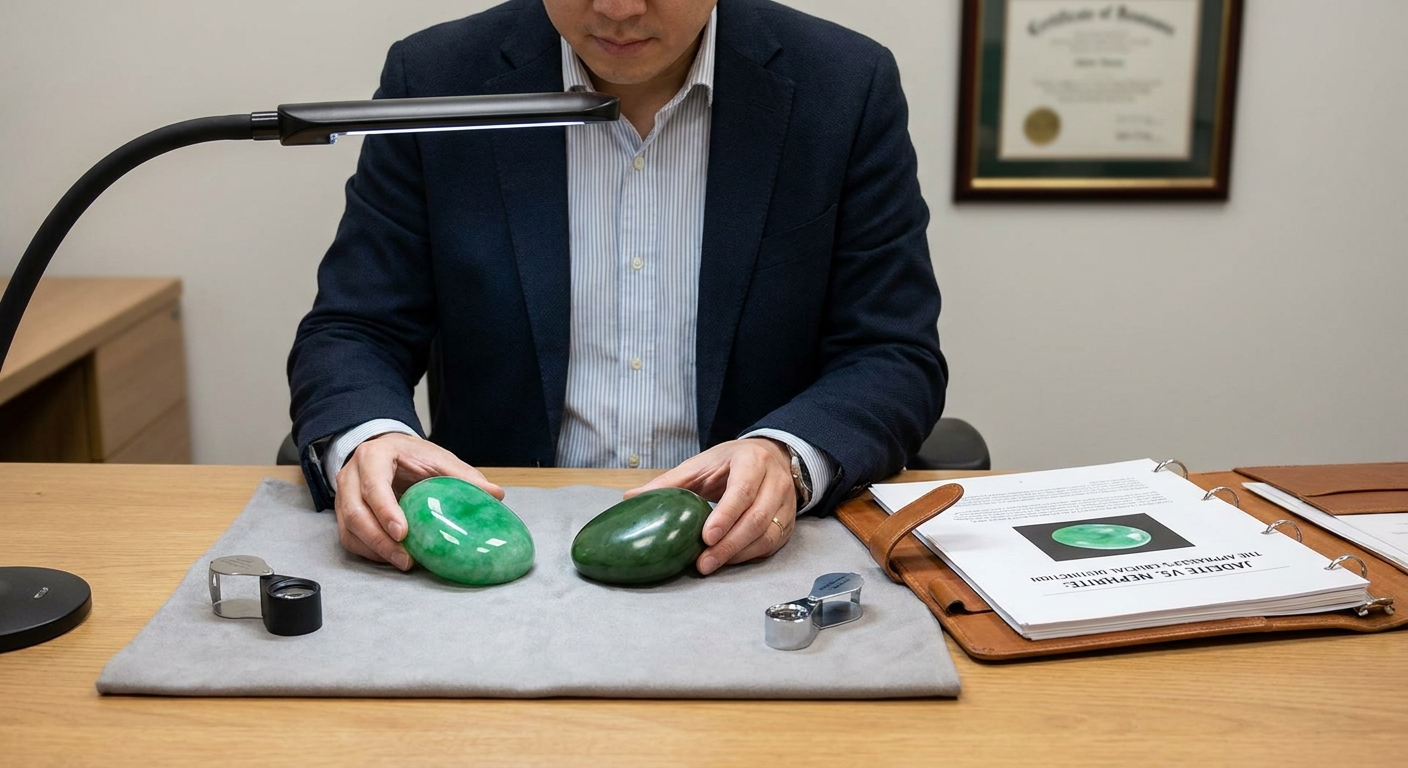
Imagine a client walks into my office, a beautiful, intricately carved pendant clutched in their hand. Their eyes sparkle with excitement as they explain, "This has been in our family for generations. We’ve always been told it's precious jade, worth a fortune!" It’s a common scenario, and one that immediately flags the critical distinction an appraiser must make: is it jadeite, or is it nephrite? The answer can mean the difference between a modest valuation and a truly significant one. This isn't just an academic exercise; it's a fundamental part of providing an accurate, ethical appraisal.
My first step is always a thorough visual inspection. Jadeite often presents with a more vitreous, almost glassy luster, and its colors can be incredibly vibrant – think of the coveted imperial green, a rich, emerald-like hue. It can also appear in lavender, white, black, or even multi-colored combinations, often with a fine granular texture. Nephrite, on the other hand, tends to have a waxier, sometimes greasy sheen, with colors often more muted, like spinach green, creamy white, or dark forest green. Its texture is typically more fibrous. While both are tough, their appearance tells a story. I'm looking for the subtle hints that point to one mineral over the other, noting translucency, uniformity of color, and any visible inclusions.
Beyond the initial visual, understanding the distinct physical properties is paramount, even if I’m not performing the lab tests myself. Jadeite has a higher specific gravity (SG), typically around 3.33, compared to nephrite’s average of 2.95. This means jadeite feels noticeably denser for its size. Similarly, their refractive indices (RI) differ. While I've completed basic gemstone courses and am adept at visual identification, I'm not a GIA certified gemologist. This is where my network and knowledge of best practices come in. Knowing these benchmarks helps me form an educated opinion and, crucially, understand when to recommend further laboratory testing by a GIA gemologist for definitive confirmation. For instance, if a piece exhibits characteristics that straddle the line, suggesting a referral for a professional lab report is the responsible and professional course of action.
This brings us to the crucial concept of "Type A, B, C" jade, a framework that directly impacts valuation. Type A jade refers to natural, untreated jadeite. Type B has been chemically bleached to remove impurities and then impregnated with a polymer resin to improve its appearance and stability. Type C is dyed, often to enhance or alter its color. The presence of such treatments drastically impacts value, sometimes reducing it by orders of magnitude. A skilled appraiser must be alert to the signs of these treatments, such as a slightly duller luster in Type B, or dye concentrations in fissures for Type C, and be prepared to recommend laboratory analysis for conclusive identification.
I recall a particularly striking example: a client presented a large, beautifully carved bi disc. It had a lovely translucent green color, and at first glance, some characteristics hinted at good jadeite. However, its luster leaned more waxy than vitreous, and the "cold touch" test – jadeite feels colder to the skin and retains that coolness longer than nephrite – suggested otherwise. My initial assessment, based on its specific gravity and visual cues, pointed to nephrite. While the client had hoped for jadeite, understanding the distinction allowed for an accurate appraisal based on its true identity, craftsmanship, and historical significance as a fine nephrite carving. Managing expectations with clear, evidence-based reasoning is a cornerstone of our profession.
If you own a piece of jade and are curious about its true nature and value, seek out a qualified personal property appraiser with specialized experience in jewelry and gemstones. They can provide an informed opinion, guide you on potential lab testing if necessary, and ensure you receive an accurate valuation grounded in market realities and gemological distinction.