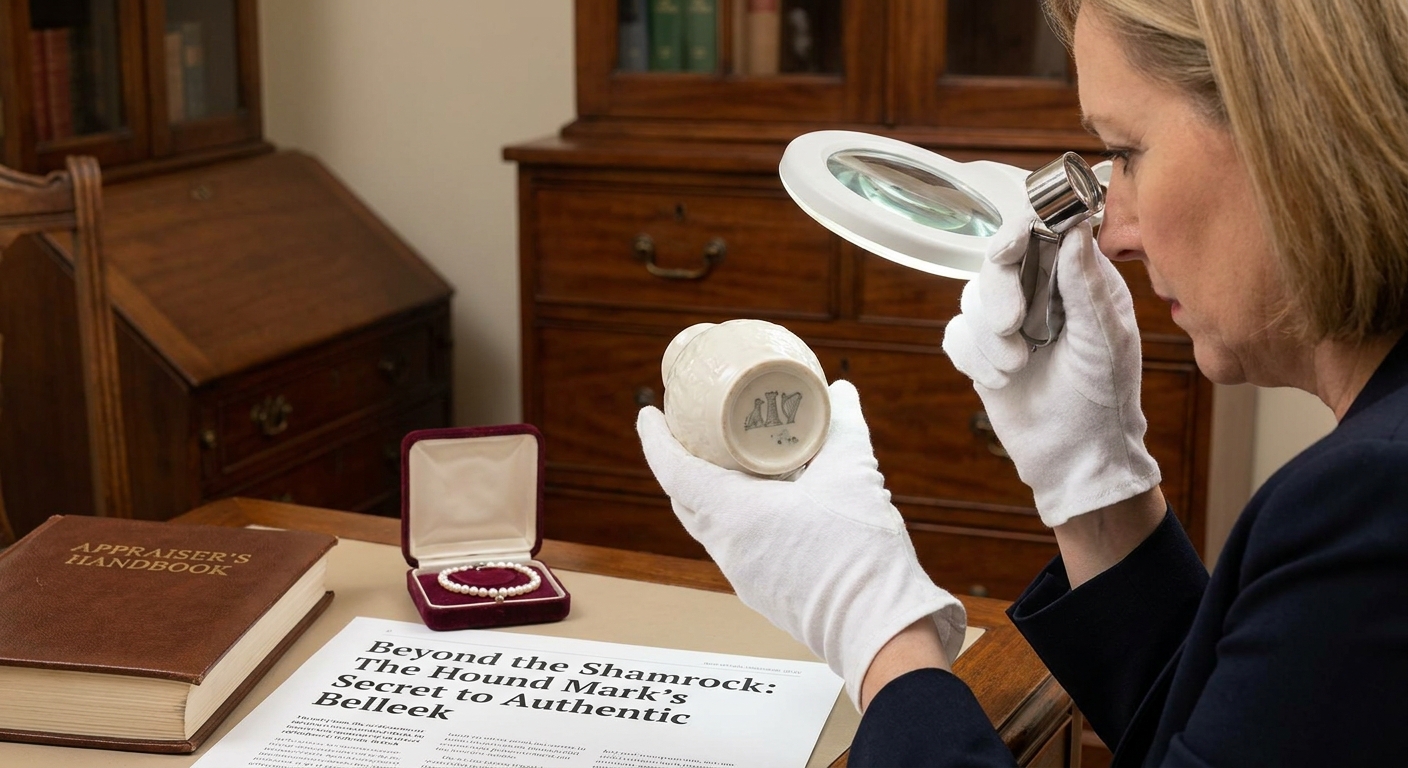
It’s a common scenario: a client brings in a beautiful piece of Belleek porcelain, often an inherited treasure or a lucky find from an estate sale. They’re beaming, confident in its age and value, pointing to the delicate shamrock on the base as definitive proof. "Look, Jessica," they'll say, "it’s clearly old Belleek, it has the shamrock!" And while the shamrock is indeed an iconic motif of the Irish pottery, it’s not always the secret key to unlocking significant value or even confirming the earliest, most sought-after pieces. Many later, less valuable pieces also proudly display that beloved clover.
As an appraiser with over a decade of experience navigating the nuances of collectibles, I can tell you that authenticating truly valuable Belleek goes far beyond the familiar shamrock. The real secret often lies in understanding the evolution of its backstamps, specifically looking for the presence and style of the Irish wolfhound, particularly in the earliest, most coveted "black marks."
Here's a strategy I often employ: First, prioritize the "Black Marks." Belleek's earliest pieces, produced from 1863 to around 1946, bear a series of black printed marks. The very first of these, known as the First Black Mark (1863-1890), is a complex design featuring a Fermanagh castle, a harp, a shamrock, and crucially, an Irish wolfhound. This wolfhound is a powerful indicator of early production. The Second Black Mark (1891-1926) simplifies slightly but retains the castle, harp, shamrock, and that distinctive wolfhound. Even the Third Black Mark (1926-1946) continues this tradition, although the design becomes more stylized. If you find a clear, well-struck black mark with the wolfhound, you're likely holding a piece from Belleek's golden age. This isn't just about age; it's about scarcity and historical significance, which directly correlates to market value.
Second, look beyond the mark to the piece's intrinsic qualities. While the mark is paramount, the physical characteristics of early Belleek are equally telling. These pieces are renowned for their incredible translucency, often described as eggshell thin, allowing light to pass through them beautifully. The glaze is a creamy, iridescent parian china, distinct from later, more opaque formulations. Examine the craftsmanship: are the basketweave patterns incredibly delicate? Is the hand-painting precise? Early Belleek often feels lighter and more refined than its modern counterparts. This holistic approach, combining mark identification with material analysis, provides a robust framework for authentication.
In practice, I recently appraised a small Belleek basket that a client had dismissed as "just an old shamrock piece." Upon closer inspection, under magnification, I discerned a faint but unmistakable First Black Mark, complete with the tiny wolfhound. The piece also exhibited that characteristic ethereal translucency. This discovery transformed its valuation from a modest decorative item to a significant collector's piece, reflecting its true historical and artistic importance.
This process underscores the importance of due diligence in mark identification. Relying solely on a superficial identifier like a shamrock can lead to significant misjudgments in value. The subtle variations in Belleek's marks, particularly the presence and style of the wolfhound in the black marks, are critical signposts for authenticity and desirability.
For anyone holding what they believe to be valuable Belleek, or any antique for that matter, understanding these nuanced details is key. Don't let a common symbol mislead you. A professional appraisal delves into these specifics, meticulously researching marks, forms, and market comparables to provide an accurate, evidence-based valuation. It ensures you truly understand the story and worth of your cherished possessions, going beyond surface appearances to uncover their genuine secret.