The Clarity Plotting Guide
A visual and procedural dictionary for mapping diamond characteristics. Accurate plotting is the foundation of determining a diamond's clarity grade.
The Color Rules
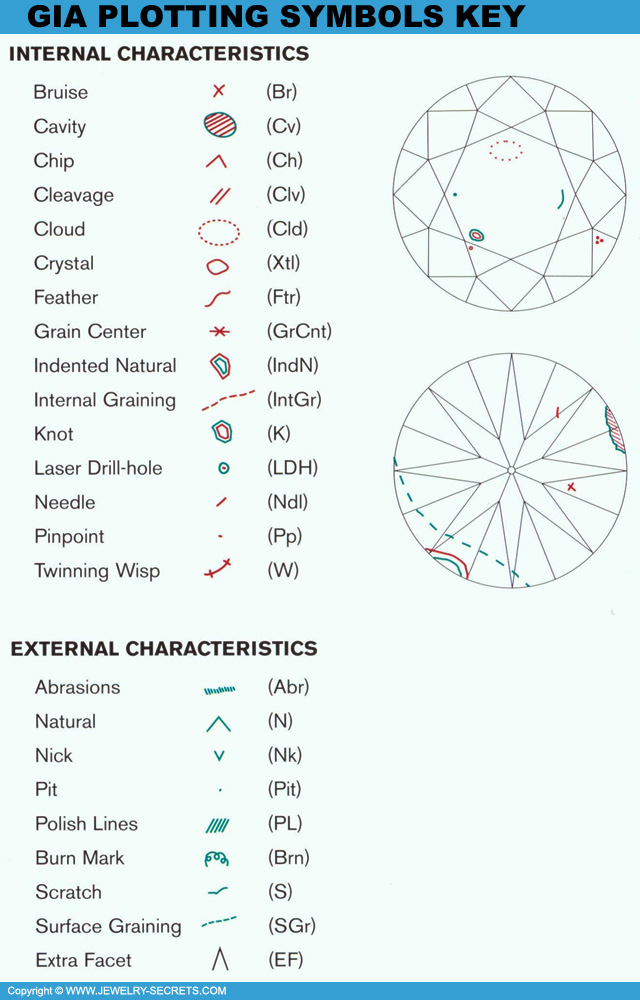
GIA uses a strict color-coding system to differentiate between internal characteristics, external characteristics, and extra facets. You must use the correct color ink.
Red Ink
Internal Characteristics (Inclusions)
Used for anything inside the stone. If an inclusion is completely enclosed within the diamond, it is plotted solely in red.
- Crystals
- Feathers
- Pinpoints
- Clouds
- Needles
Green Ink
External Characteristics (Blemishes)
Used for features confined entirely to the surface of the diamond. They do not penetrate the interior.
- Scratches
- Naturals (if surface only)
- Abrasions
- Polish Lines
- Extra Facets (Black in older systems, mostly Green now depending on lab specific policy, but strictly surface)
Red & Green
Surface-Reaching Inclusions
Used when a characteristic extends from the inside of the stone to the surface. The outline on the surface is green, the interior depth is red.
- Cavities
- Indented Naturals
- Knots
- Laser Drill Holes
The Plotting Sequence
Plotting requires a systematic approach. Never jump around. Follow this sequence to ensure you don't miss grade-setting characteristics or waste time plotting minor features that won't affect the grade.
Locate the Grade-Setting Characteristics
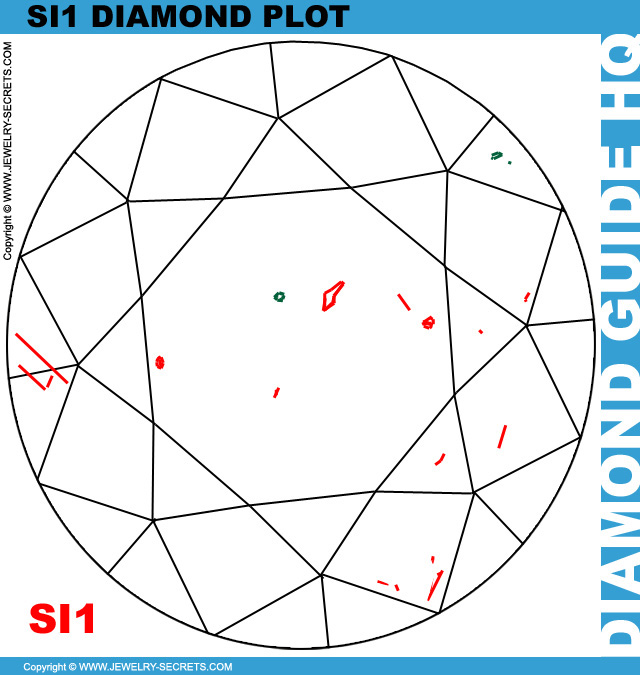
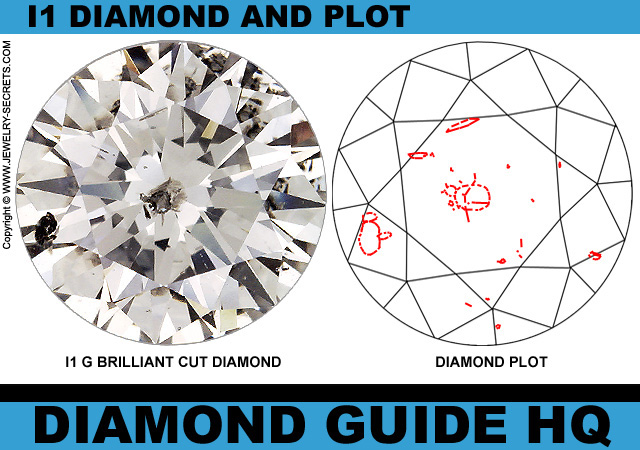
Start by observing the diamond face-up (through the table). Identify the most prominent inclusions—these are your grade setters. Plot these first, as accurately as possible regarding size, shape, and location relative to the facet junctions.
Plot Remaining Table Inclusions
Still looking face-up, locate and plot any other internal characteristics visible under the table facet. Remember to use Red ink.
Move Outward (Crown Facets)
Scan the star, kite (bezel), and upper girdle facets. Plot any inclusions found here. Use the facet junctions on the diagram as your coordinate system to place them exactly.
Examine the Pavilion
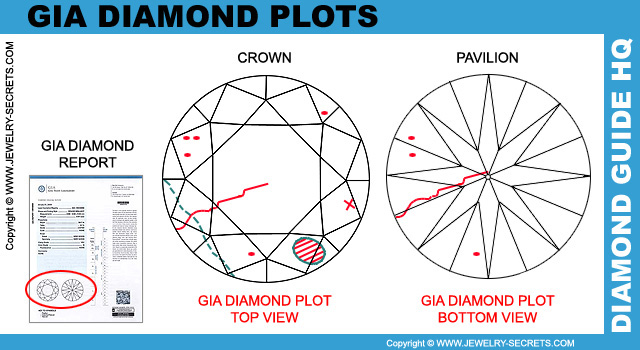
Turn the stone over (culet up). Plot internal characteristics visible through the pavilion facets on the pavilion diagram. Rule: Only plot an inclusion on the view (crown or pavilion) where it is most visible, unless it spans across the girdle.
Map Surface Blemishes
Finally, switch to Green ink. Scan the surface of the crown, pavilion, and girdle for scratches, abrasions, naturals, or extra facets. Plot these accurately.
Note: If identifying a surface-reaching inclusion (like a cavity), outline the surface opening in green and fill/shade the interior depth in red.
Common Internal Symbols (Red)
Crystal (Xtl)
A mineral crystal contained in a diamond. Drawn as a red outline reflecting its general shape (circle, polygon).
Pinpoint (Pp)
A tiny crystal that looks like a dot at 10x. Plotted as a single red dot.
Cloud (Cld)
Many tightly grouped pinpoints. Outlined with a red dotted line encompassing the area.
Needle (Ndl)
A long, thin crystal that looks like a tiny rod. Drawn as a straight red line.
Structural & Cleavage Symbols (Red)
Feather (Ftr)
A general term for any break (cleavage or fracture). Drawn as a jagged or curving red line with small "tick" marks.
Twinning Wisp (TW)
A cloudy area produced by crystal distortion during growth. Drawn as a curving line with tick marks crossing it.
Internal Graining (IntGr)
Lines or angles inside the stone caused by crystal growth. Drawn as solid red parallel lines. (Note: Often only noted in comments if not prominent).
Surface Blemishes (Green)
Scratch (Scr)
A linear, shallow mark on the surface. Drawn as a single, smooth green line.
Extra Facet (EF)
A small facet not required by the cut style. Outlined in green reflecting its shape.
Natural (Nat)
A portion of the original rough skin left on the polished stone, usually on the girdle. Drawn as a thick green line along the girdle outline.
Surface-Reaching Inclusions (Red & Green)
Cavity (Cav)
An angular opening on the surface resulting from a part of a feather breaking away, or a crystal dropping out during polishing.
Plotting Rule: Outline the shape of the surface opening in Green, and fill the interior shape solidly with Red.
Indented Natural (IndN)
A portion of the original rough that dips into the diamond, usually occurring on the girdle.
Plotting Rule: Outline the surface perimeter in Green, and fill the inward-dipping area solid with Red.
Trick Identifications: Side-by-Side
Some characteristics look similar but require different symbols. Proper identification is key to a correct plot.
Pinpoint
A tiny dot under 10x magnification. It has no discernible shape other than a point of light or dark.
Crystal
Has a discernible shape (volume) at 10x. Even if it's very small, if you can see an outline or depth, it's a crystal, not a pinpoint.
Feather
A generic term for a break. Often looks whitish, feathery, or highly reflective depending on the lighting angle.
Needle
A solid, elongated crystal. Unlike a feather, a needle is typically straight, looks like a rod, and won't flash like a flat break.
Scratch
Strictly on the surface. Usually a straight or slightly curving white line. Looks like a scrape.
Feather (reaching surface)
Penetrates the stone. While it may start at the surface, it has depth. You must look into the stone to see its extent.