GIA G230 Diamonds & Diamond Grading
Synthetics, Simulants & Treatments
A rapid-reference diagnostic matrix designed for professional appraisers. Identify lab-grown signatures, recognize enhancement treatments, and separate common simulants in the field and at the bench.
Appraiser's Note
Always utilize proper magnification (10x loupe or microscope with darkfield illumination) when searching for these identifiers. When in doubt, advanced laboratory testing is required for definitive separation of natural vs. synthetic.
Diagnostic Matrix
| Category | Subject | Key Microscopic / Optical Signatures | Lighting / Tools Needed |
|---|---|---|---|
| Lab-Grown | HPHT (High Pressure, High Temperature) |
|
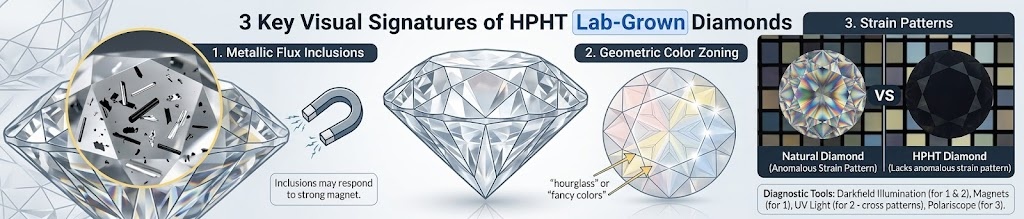
Darkfield illumination, Magnets, UV Light (often fluoresces cross-shaped patterns). |
|
|||
| CVD (Chemical Vapor Deposition) |
|
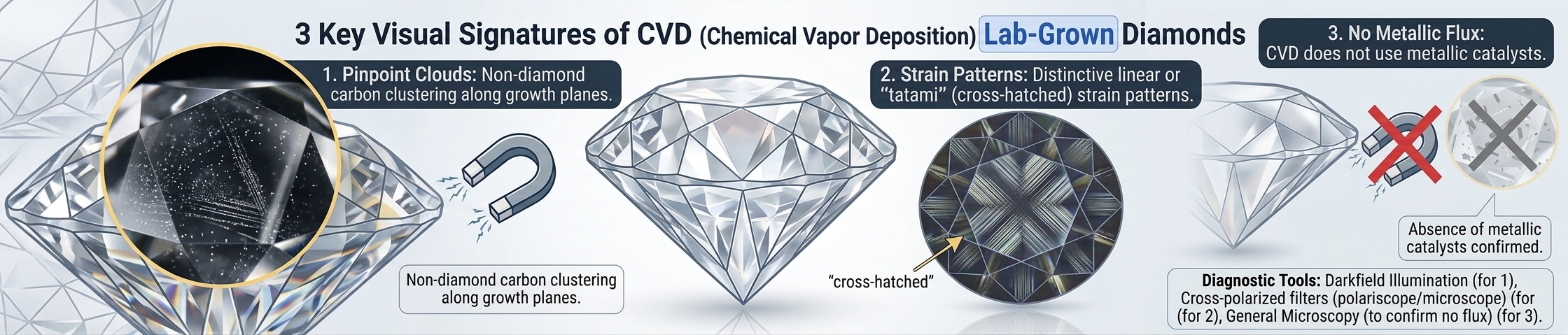
Cross-polarized filters (polariscope/microscope) for strain, Darkfield for pinpoints. | |
|
|||
| Treatments | Fracture Filling |
|
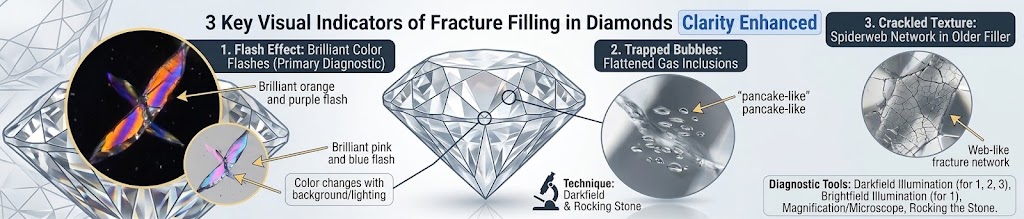
Darkfield & Brightfield illumination (rocking the stone gently to catch the flash). |
|
|||
| Laser Drilling |
|
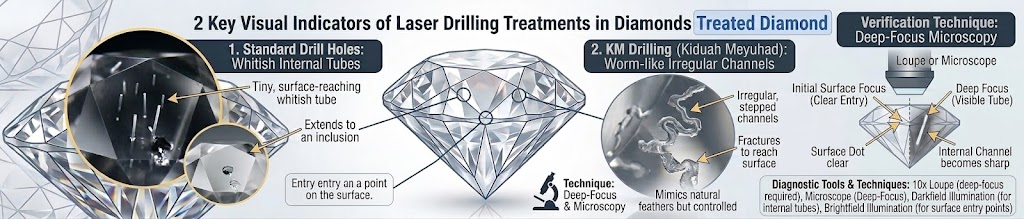
10x Loupe or Microscope (focusing deeply into the stone from the surface). | |
|
|||
| Simulants | Moissanite (Synthetic SiC) |
|
10x Loupe (viewing at an angle), Thermal/Electrical testers (can give false diamond readings on older thermal testers). |
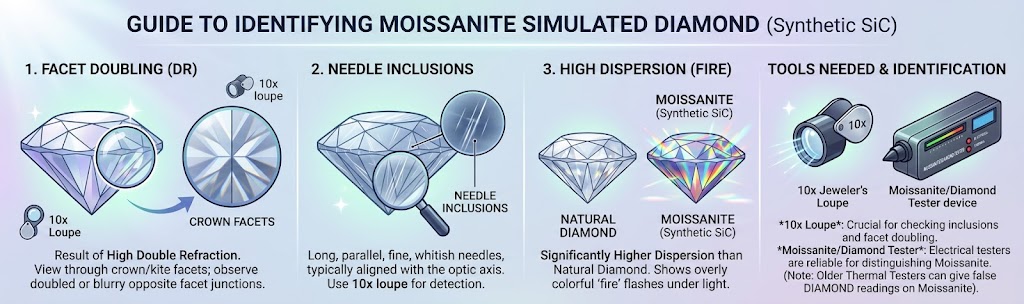
|
|||
| Cubic Zirconia (CZ) |
|
10x Loupe (checking for abrasions), Scale & Calipers (for estimated weight vs actual), Standard Thermal Tester. | |
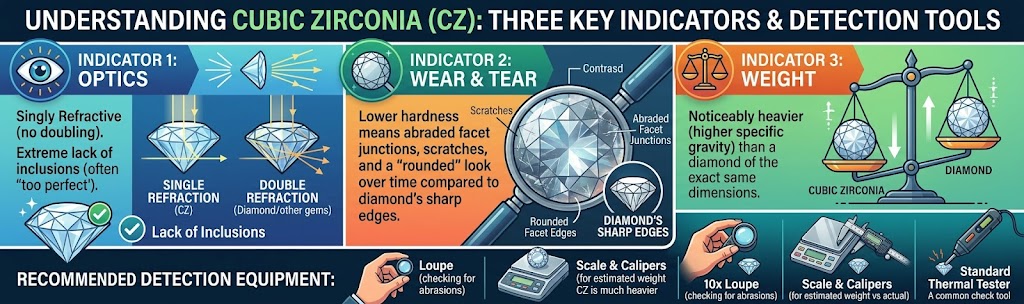
|
|||
Advanced Field Screening: Lab-Grown vs. Natural Diamonds
1. Girdle Inscriptions
Most lab-grown diamonds are legally required to carry a microscopic laser inscription on the outer edge (the girdle). Under a 10x jeweler's loupe, you will see a registry number alongside explicit text such as LABORATORY GROWN or LG.
2. Advanced Gemological Equipment
Professional jewelers and independent gem labs rely on specialized, high-tech devices to screen stones.
Type IIa Screening (Infrared Spectrometers)
Roughly 98% of natural diamonds contain trace amounts of nitrogen (Type Ia). Conversely, nearly all lab-grown diamonds are structurally engineered to be chemically pure carbon, classified as Type IIa. Screening tools check the stone's light absorption properties; if it flags as Type IIa, it is highly likely to be lab-grown and must be sent for further analysis.
Aura IQ Diamond Tester
$3,995.00Vendor: Pepetools
Photoluminescence and UV Imaging: Systems look at fluorescent graining patterns under varying wavelengths of UV light. Natural diamonds show millions of years of erratic growth, while lab stones glow under patterns tracing modern manufacturing (sharp layered growth of CVD or hourglass patterns of HPHT).
SmartPro MAX
$1,345.00Domain: smartproinstrument.com
Dual Thermal & Optical Conductivity: Standard selectors only check if a stone is a diamond or a fake simulant (like CZ). Multi-probe testers utilize combined thermal and complex optical sensor checks to accurately read differing microscopic structures caused by a diamond's rapid growth acceleration in a lab.
3. Microscopic Inclusions Analysis
When viewed under high-powered gemological microscopes, the microscopic structural imperfections (inclusions) trapped inside the stone tell the true story of its geological or synthetic origin:
HPHT Growth Inclusions
Because HPHT diamonds are grown inside intense metallic molten flux solutions, they often trap microscopic specks of industrial metals (like iron, nickel, or cobalt). These look like tiny, dark metallic opaque shapes that do not exist in natural diamonds.
CVD Growth Inclusions
CVD diamonds are grown line-by-line via a carbon plasma gas cloud. Under specialized magnification, they can reveal distinct, perfectly linear parallel growth lines or unique dark carbon pinpoint clusters.
Natural Earth-Mined Inclusions
Earth-mined diamonds contain organic imperfections formed over billions of years, such as tiny trapped crystals of other natural minerals (like garnet), feathers, or cleavages that follow natural geological fault lines.
Field Appraisal Quick Tips
The Magnets Test
A strong neodymium magnet can sometimes attract HPHT synthetic diamonds due to the metallic flux remnants. If a mounted stone reacts to a magnet, proceed with extreme caution and recommend lab testing.
Finding the Flash
Fracture fillers have a different refractive index than diamond. To spot the flash effect, slowly rock the diamond back and forth under a focused light source. The color will suddenly "flash" as the angle changes.
The Tilt Test (Moissanite)
Moissanite is cut to hide its double refraction when viewed straight down through the table. You must tilt the stone and look through the crown/kite facets toward the culet to spot the facet edge doubling.